Studio Diary: The Marking Time Sculpture at Bronllys Hospital, Powys.part 6.

12973278_1143541808998948_8956690424513039222_o


OLYMPUS DIGITAL CAMERA

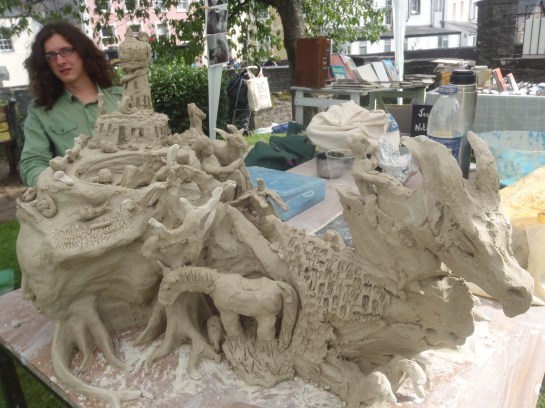
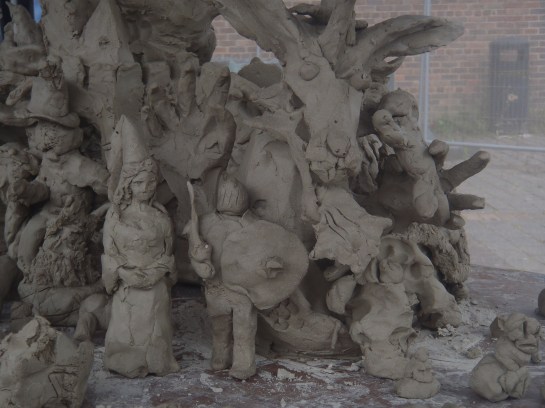
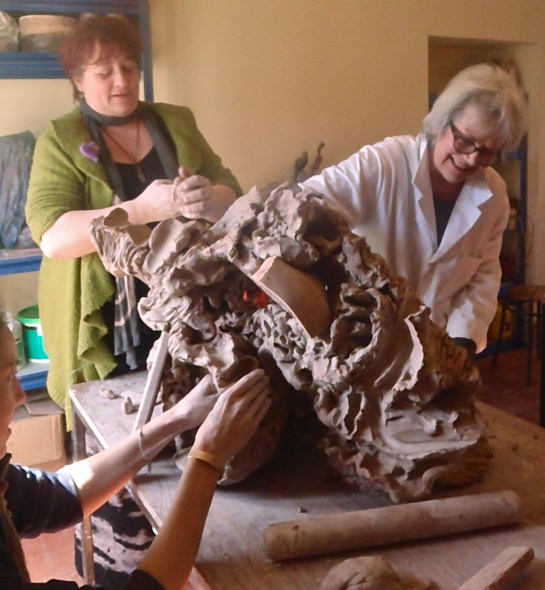
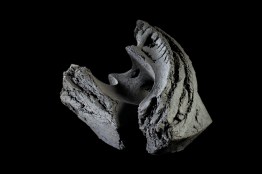
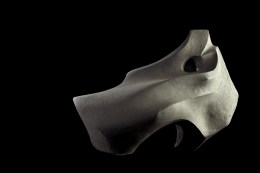
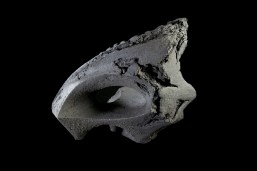
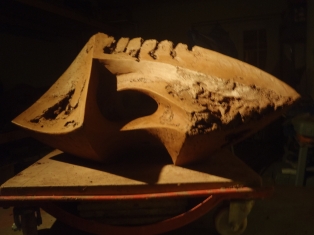
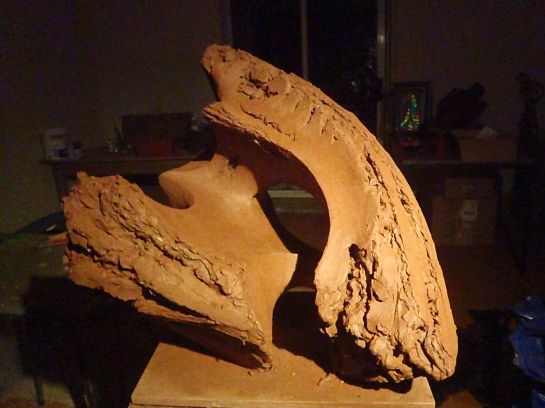
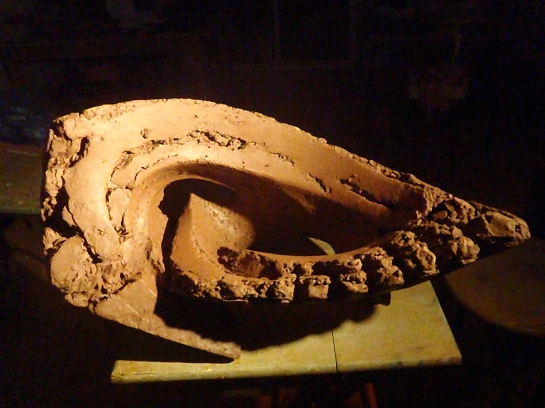
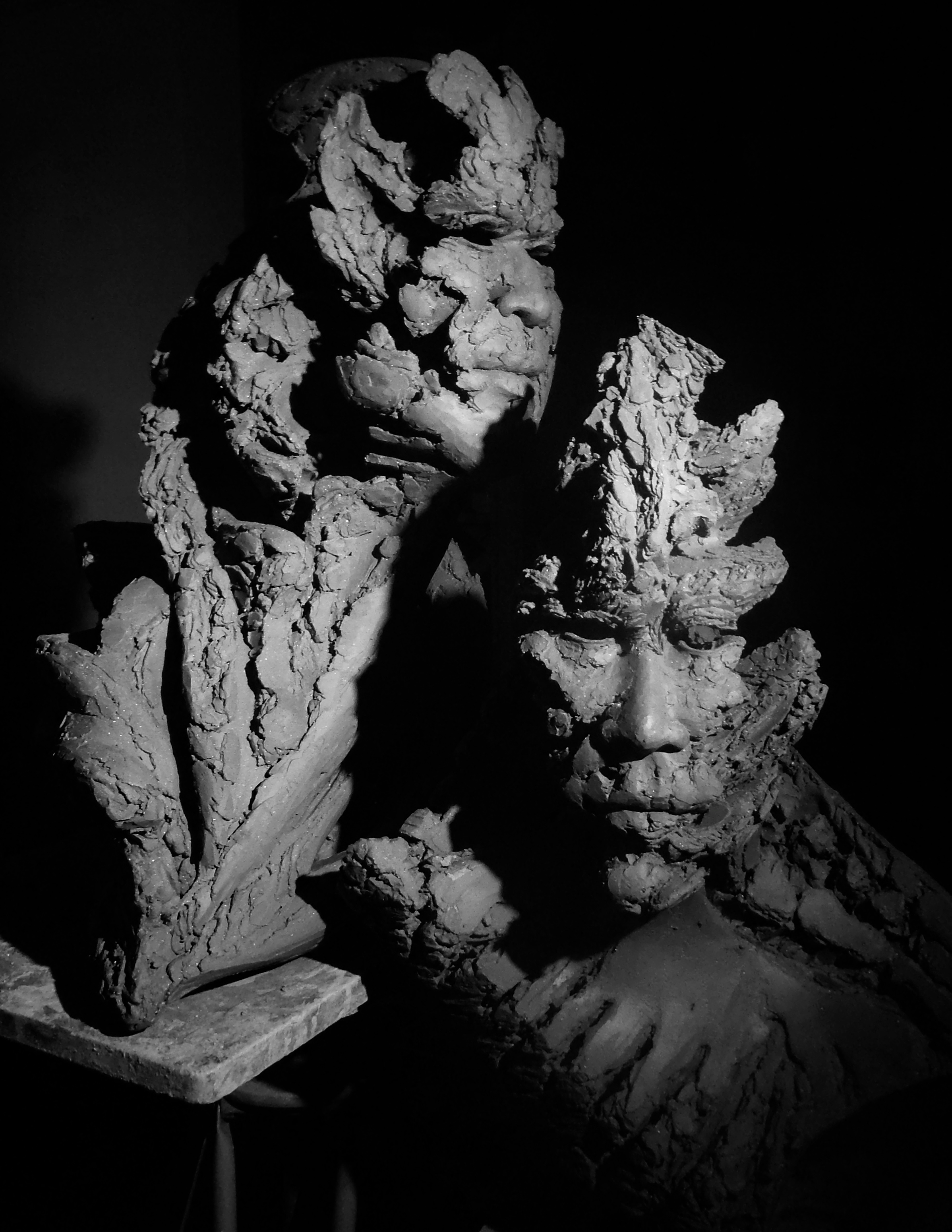
Things are progressing really well. The intense texture, which will look great in the woodland light, is developing  strong patterns and as the curves get tightened up there is lots of flowing movement.


OLYMPUS DIGITAL CAMERA

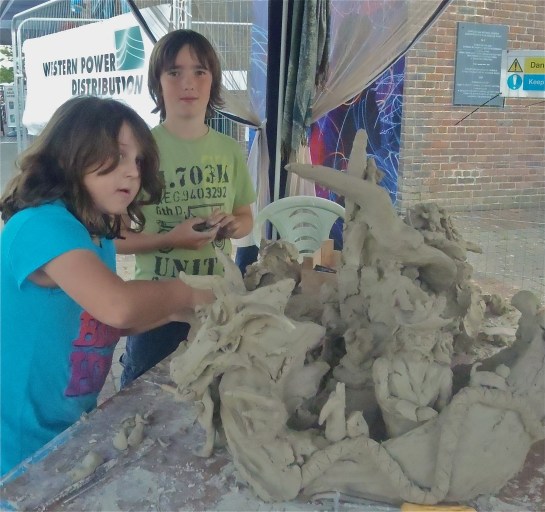
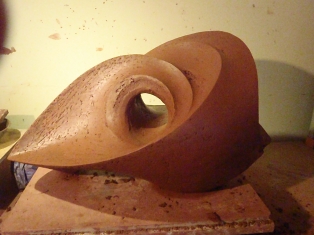
The birds head is done and the dragon’s is getting there. The main thing, a powerful embrace,  is there and when the blue mosaic is in place in the centre it will look enchanting.

OLYMPUS DIGITAL CAMERA

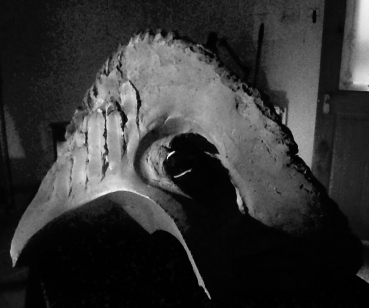
Our foster-kittens are being very helpful with lots of feed-back. It will soon be time to cut the sections and begin the long slow dry.

OLYMPUS DIGITAL CAMERA

13100787_1154117107941418_2671826753378633333_n

These fabulous images are from the wonderful Black Eagle Project.

13083332_1154117131274749_729383849478642843_n

Studio Diary: The Marking Time Sculpture at Bronllys Hospital, Powys.part 5.

Marking Time Sculpture for Bronllys Hospital, Powys, UK.

Marking Time Sculpture for Bronllys Hospital, Powys, UK.

The full structure is built and the 1st layer of the textured surface is on. It has been every bit as challenging as I hoped!

Marking Time Sculpture for Bronllys Hospital, Powys, UK.

Marking Time Sculpture for Bronllys Hospital, Powys, UK.

The next stage is developing  the surface to enhance the flow of the curves. The clay with extra grog added will go on in layers using ever-smaller tools. It takes a great deal of time but it will leave fascinating, subtle surfaces and edges that are also very strong.

Marking Time Sculpture for Bronllys Hospital, Powys, UK.

Marking Time Sculpture for Bronllys Hospital, Powys, UK.

In these early stages it can look distractingly chaotic. Any part that just doesn’t work well can be removed and redone.

Mick Farrell and Janet Epplestone visiting Osprey Studios to help with their very useful feed-back.

Mick Farrell and Janet Epplestone visiting Osprey Studios to help with their very useful feed-back.

It was lovely to have Mick and Janet call in to give me their objective feed-back. And some gorgeous flowers for my birthday! I will get in as many people as I can to double-check how the piece is being read. The Red Kite is becoming very clear. Bringing together the Dragon will be the trickiest bit.

Marking Time Sculpture for Bronllys Hospital, Powys, UK.

Marking Time Sculpture for Bronllys Hospital, Powys, UK.

How To use/do Join-in Sculpture Workshops

12971082_1191540624198015_4224611240142021105_o

This time we used a tricky technique of building hollow and looking at portrait skills because the participants were sophisticated and really skilled.


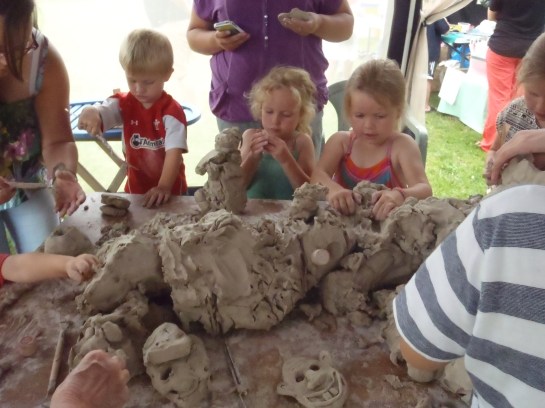
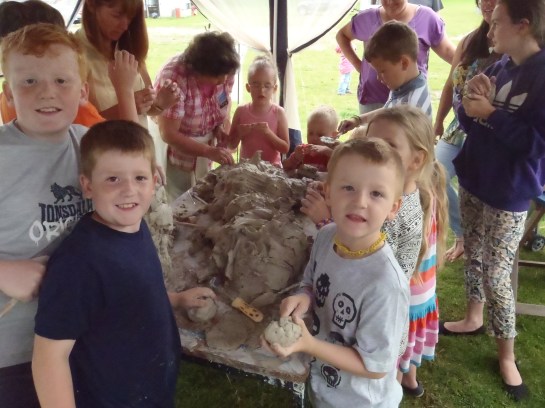
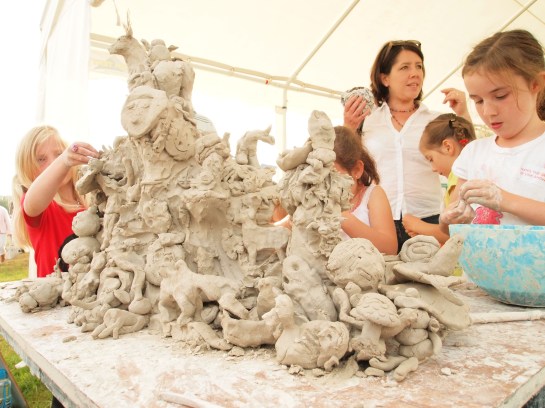
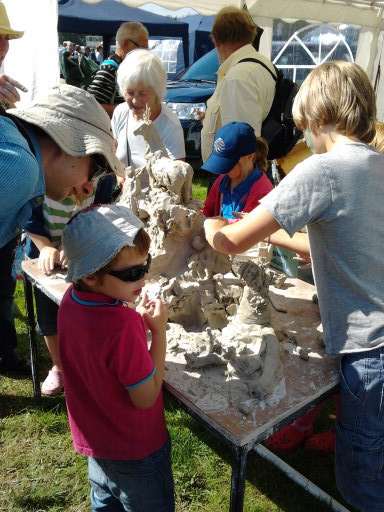
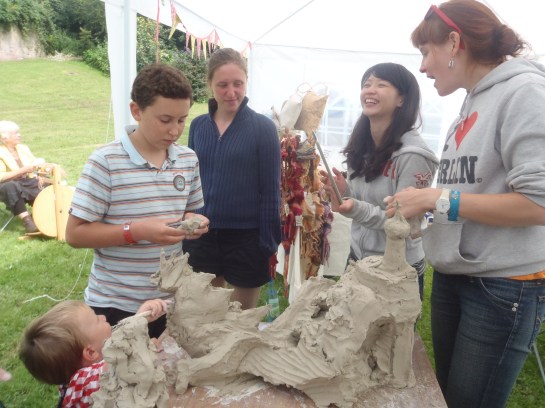
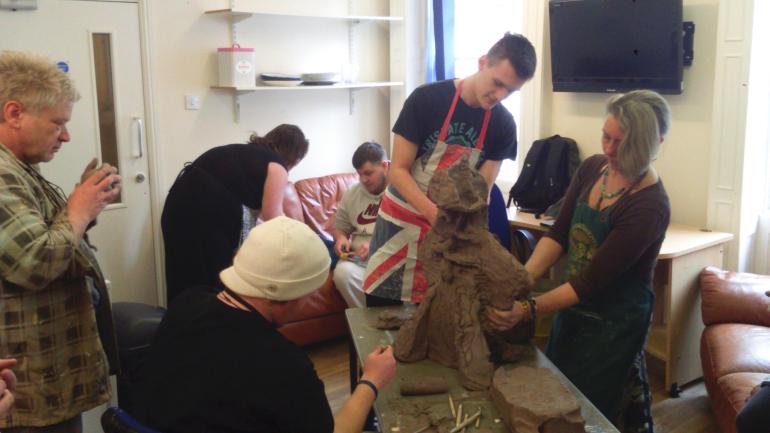
Join-In Sculptures are great fun and full of learning opportunities. I have done these with adults and children at Events and Parties ; Everyone adds their bit until we have a fabulous sculpture. Photos are taken and then we re-cycle the clay.Brecon Jazz Join-In Sculpture

They can be adapted to fit any group or space.  The key is for it to be a challenge to create the excitement and the rewarding achievement. Because all the clay is recycled, they are a cost-effective way to give people a chance to experience quality materials, tools and the challenges and buzz of making something on a large scale. Hesitant participants get a lot out of their contribution being part of something complex and big.

Making a Zoo complete with 4 toilets, a car park and an over-looking military complex. We worked on this all day, took photos and then squashed it all up. Fantastic fun, lots of skill sharing and teamwork.

Making a Zoo complete with 4 toilets, a car park and an over-looking military complex. We worked on this all day, took photos and then squashed it all up. Fantastic fun, lots of skill sharing and teamwork.

Clay is a fantastic material for kids. They relate to it immediately and it usually engages their attention for surprisingly long periods. The majority of Pupils will learn best when their hands are busy. It is the 3D equivalent of Drawing; it’s not just for arts and crafts; it’s versatility and affordability means it can be used to enhance all sorts of subjects even maths or history. Many children will find expressing and accessing their ideas in 3D much more natural than using 2D and for some it will be much easier than using words.

Click here for more info about using clay affordably in schools.

Theatr Brycheiniog's Kid's Zone at Brecon Jazz 2014

Theatr Brycheiniog’s Kid’s Zone at Brecon Jazz 2014

Theatr Brycheiniog's Kid's Zone at Brecon Jazz 2014

Theatr Brycheiniog’s Kid’s Zone at Brecon Jazz 2014

OLYMPUS DIGITAL CAMERA

A Join-In Sculpture with The Big Skill at Archaeology For All in Merthyr.

A Join-In Sculpture with The Big Skill at Archaeology For All in Merthyr.

The quality clay is the important item. Clays are made with recipes and therefor there is an infinite number of types of clay, each with particular properties. ES70 is absolutely lovely to use; it feels very nice, it’s not sticky, it doesn’t stain, it’s easy to clean up ( on carpet let it dry + brush out), it’s not irritating to sensitive skin and you can eat it! Most importantly it is very easy to use so people get good, rewarding results quickly. Beginners deserve a great material that will reward their bravery for trying something new and give them fab results that will spur them on.

ES70 works very well as a self hardening clay and can be decorated with poster paints once it’s dry.

Plan to recycle all the clay, even if it’s painted or has dried completely. Explain that the clay is expensive so you need to keep it for next time so that they don’t think it’s because you assume they will make rubbish! Pupils are usually perfectly happy to let it go. Often it takes the pressure off to make a ‘product’ and they can relax and enjoy the making part more.

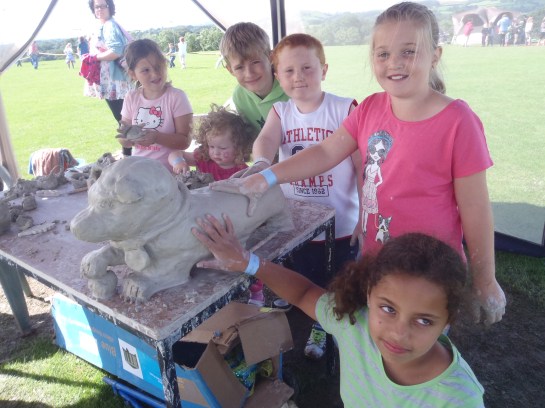
Clayton The Rottweiler has a full set of internal organs including a working bladder! At the end of the session we recycled the clay.

Clayton The Rottweiler has a full set of internal organs including a working bladder! At the end of the session we recycled the clay.

Monmouth Show w/ The Big Skill

With The Big Skill at the Monmouth Show.

The Usk Show.w/ The Big Skill

At the Usk County Show.

Join-In Sculpture at Brecon Jazz

The Join-In Sculpture brings people of all ages together.

Re-using the Clay

-At the end of a session drop all the clay back in the bag. (lots of pupils will love smashing the work up!)

-Put bag in Bucket

-slowly pour  a cup or so of water over the clay in the bag to soften the clay.

-Close bag w/ twisty

-leave  over night or longer.

-place bag on floor and step on it a few times to “knead” the clay, turning bag a few times.

-Voila! It is ready for use. You can re-cycle your clay endlessly.

!? Bag goes rock-hard; Allow to dry completely, drop lump on floor to break up, put pieces in bag and recycle

!? Bag goes quite hard; knock holes all over lump.(hammer + screw driver= surprisingly satisfying task!) Return to bag and recycle.

!? Bag goes too squishy; Tip clay onto a board and allow to dry until useable. “Knead” a few times over the day (or two) so that it dries evenly.

For larger quantities of clay recycling click here.

Storage

-Always close bag tightly w/ twisty

-Ideally store in a handy frost free place but it doesn’t matter  if the clay freezes.

-Ideally have the bucket on wheels as 12.5kg is quite heavy (plant pot wheels – Home-Bargains, £1.99.)

OLYMPUS DIGITAL CAMERA

Using a Join-In Sculpture to warm up students at an abstract sculpture workshop

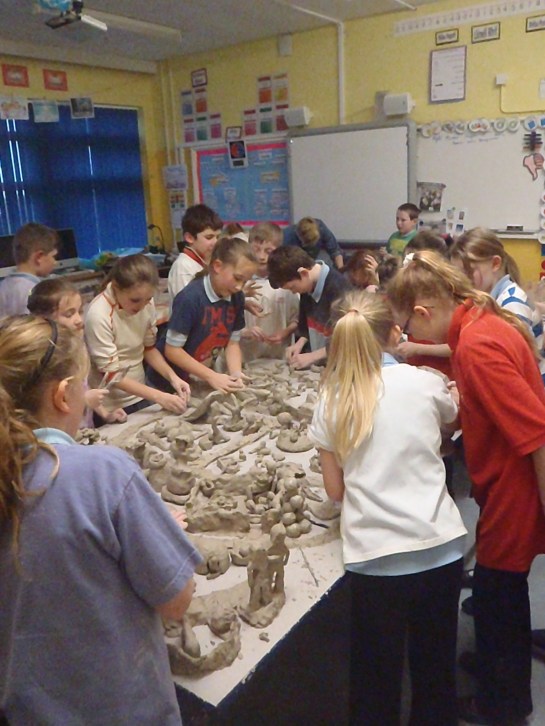
Mount Street Junior School, Years 3 and 4 making a model of a town that cares for and supports it's Military members.

Mount Street Junior School, Years 3 and 4 making a model of a town that cares for and supports it’s Military members. This time the Join-In Sculpture played a key role in the community consultation phase of the Bronllys project, Marking Time.

Click here for information about tuition and Workshops with Osprey Studios.


The Big Skill at SHYPP – Supported Housing for Young People Project.

11959984_1396460213707597_2050975536215992796_n-1

Fibre artist Emma Bevan’s Ffolkyffelt bring people together with new ways to express themselves.

Working for  The Big Skill takes you to all sorts of great places and amazing people. The equally awesome and broad-thinking group, Herefordshire New Leaf brought us in to spend the day with SHYPP in Leominster.

The wide mix of people at SHYPP are wonderful. They are working together, supporting each other, daring to be open and creative even in one of the most difficult situations anyone can face. Being homeless is a nightmare especially if you are so young. Their website describes the work they do project perfectly:

SHYPP provides 16 – 25 year olds across Herefordshire with housing, training and employment opportunities.

We provide a range of accommodation suitable for young people at different stages of their lives including foyer accommodation, move on flats, shared houses and supported lodgings.

We are not just about accommodation we work with young people through training programmes and a wide range of activities.  SHYPP wants to give Young People the opportunity to develop independent living skills, identify their talents and go on to live happy and successful lives.  SHYPP also provides floating support to assist Young People in their own homes, enabling them to access accommodation, maintain accommodation and help with debt management.

SHYPP is a service driven by what young people want, this means projects develop according to their needs.”

The SHYPP Blog. is excellent and SHYPP’s  Facebook. has the same warm, positive, up-lifting feel.


The Big Skill goes well out of it’s way help fab groups like SHYPP to fulfil their best ambitions and it’s great to be part of it.

The Join -In sculptures are excellent: they can be adapted to fit any group or space. This time we used a tricky technique of building hollow and looking at portrait skills because the participants were sophisticated and really skilled. The key is for it to be a challenge to create the excitement and the rewarding achievement. Because all the clay is recycled, this is a cost-effective way to give people a chance to experience quality materials, tools and the challenges and buzz of making something on a large scale.

12919925_1396460407040911_8344412175372830974_n

One of the best parts of this day was that Kevin, a sculptor local to Leominster came along see the Join-in Sculpture in action, learn about the possibilities and try out the Scarva ES 50 Crank clay so that he could offer this workshop. They bought the clay at the end of the day. Perfect.

12971082_1191540624198015_4224611240142021105_o


12938215_1396460327040919_5648409311563897776_n

Studio Diary: The Marking Time Sculpture at Bronllys Hospital, Powys.part 4.

Working on a large scale means returning to the same form everyday for months. So you need to be sure about the design.

I’m really pleased with the scale of the Marking Time Sculpture. It is within the human scale range so that the embrace and  eye level of the dragon and the kite/guardian’s wings will feel very personal.

Marking Time scale model.

Marking Time scale model.

Osprey Studios has a flexible layout and a solid floor so that anything up to 6m x 3m can be built there which keeps costs down.

Osprey Studios has a flexible layout and a solid floor so that anything up to 6m x 3m can be built there which keeps costs down.

The base foot print was painted on the floor in red and the outline of widest/deepest edges painted in blue to check that there will be space to work around the forms. The largest section is set on blocks to give the height of the eye-line. The other 2 sections are on wheels for easier access. The base footprint is painted on the boards in blue.

I always miss my wonderful Volunteers from past projects at this point. But it is a lot easier to be building in my own studio. Advancing decrepitude means some of my systems for moving heavy loads around lack dignity. And I can loose myself in the curves.

Areas are kept wrapped in plastic to keep the drying even. When you add new clay you need to allow time for the water to re-balance itself down the form. A large piece will be holding gallons of water.

Areas are kept wrapped in plastic to keep the drying even. When you add new clay you need to allow time for the water to re-balance itself down the form. A large piece will be holding gallons of water.

I am building the armature of the piece. The final surface will be added to it so I need to keep the clay at the best stage of hardness. Scarva ES50 Crank holds its water really well while still being very strong at the leather-hard stage.

I will be adding a lot of deep texture and modelling so these armature walls are very thin. In places the lines and curves of the final form are showing.

There is an internal support structure made of clay that will stay in place during the firing. It will help to support the sections when the sculpture is cut up so you need to plan them well in advance. Other materials like foam and wood are used inside just long enough for the clay to stiffen. External supports can be anything. They will need constant adjusting to accommodate shrinkage. I have a treasured collection of heavy-duty props and oddly shaped bits of wood.

There is an internal support structure made of clay that will stay in place during the firing. It will help to support the sections when the sculpture is cut up so you need to plan them well in advance. Other materials like foam and wood are used inside just long enough for the clay to stiffen. External supports can be anything. They will need constant adjusting to accommodate shrinkage. I have a treasured collection of heavy-duty props and oddly shaped bits of wood and memory foam.

The lines of the supports can be distracting.

The lines of the supports can be distracting.

2/3 of the way up. But the forms are not complete, especially width-wise. You see the movement starting in the curves of the central space. I'm using the sound-track from The Legend of Korra to keep the theme consistent across the weeks of work.

2/3 of the way up. But the forms are not complete, especially width-wise. You see the movement starting in the curves of the central space. I’m using the sound-track from The Legend of Korra to keep the theme consistent across the weeks of work.

Studio Diary: The Marking Time Sculpture at Bronllys Hospital, Powys.part 3.

This project is a joy. The Theme and the build are very challenging, which is great. And I am working  for a wonderful team  of dedicated, committed people who have been involved in it, in various ways for years. They have all put in countless hours of voluntary time. The writer and poet Mark Christmas and designer Mick Farrell, both military Veterans, have been the driving force. They made a sheltered garden at Bronllys. They have contributed significantly to the design of the Marking Time walk and sculpture and they have donated beautiful poems written especially for the woodland site at Bronllys Hospital.

This one will be set at the entrance to the woodland.

Catching a Moment

Within these woods

there is a breath to be found

to ease new life into sight and sound

transforming our world and how we see

each branch, each twig, each living tree

so when the hurt inside we feel

creates distraction with no appeal

take a walk on this path to find this rhyme

you will no longer be ‘Marking Time.’

Dedicated to those who understand.

Mark Christmas, 2015

Mark Christmas has two ongoing projects that have formed some of the back-ground to Marking Time: The Abandoned Solider  ( or on Facebook) and the TAS Project.

This one will be part of the sculptures base.

We are the child of nevermind

Who, finding dreams lost, unfind

Who, wandering, walking paths unknown

to find a woodland overgrown

And seeing in that woodland Glen

The happy minds of nevermen

Who elfin laughter laughly speak

Of how we humans keenly seek

Some new haven overhewn

And child stars of the moon

Mick Farrell, 2016.

Both of these lovely people are right there anytime I need more information or

inspiration. They have been hugely supportive and encouraging.

Mark Christmas had formed a link with Ross Bennet, the out-standing Art teacher at Llandrindod Wells High School and we planned a Workshop there.

It is not easy for a school to accommodate a Project Workshop into their packed schedules. Ross and Head-Teacher Jane Asplin went well out of their way. IMG_6150

We started with the excellent, really skilful A-Level pupils. I brought along the model and described the project and what work needed doing.

IMG_6155

These guys are working on the panels for 2 of the corners. We talked about the use of repeating patterns in art-work. Marking Time has 3s running all through it. The pupils chose an elegant celtic emblem of 3 from the internet that will also echo the curves of the sculpture. The third panel will be the same shape, show a  version of the emblem and have the Dragon story set on it with stamps by Mount Street Junior School in Brecon.

IMG_6156

I particularly liked the choice the pupils made to have the panels linked but not the same.

IMG_1273

I lost track of what year groups came along during the day because they were all equally quick on the up-take, skilful, very creative and completely charming. It was an excellent day: the pupils were thoughtful about the project, open and forthcoming with their ideas, encouraging to each other, relaxed and friendly towards me.

IMG_1275

They have a fantastic relationship with the two Art Teachers: this is clearly an Art Department that goes above and beyond every day. Other pupils dropped in from 8.30am until 4.30 to get support, information and encouragement from the teachers they trusted. The Teachers never took a break and had their lunch on the fly. They knew every pupil and cared about every piece of work. It was inspiring!

IMG_6169

I wish I had had more time to look through the pupil’s portfolios. The couple I saw were wonderful and so was all the work on the walls. Pupils are being guided to their own style at this school. And they get the opportunity to use a wide range of materials including digital. It was great to see so many boys in the A-Level group.

IMG_6173

The central mosaic will be made up of coloured glass pebbles and beautifully decorated tiles, full of vitality, made by this wonderful group.

Llandrindod High School has taken the art-work on the sculpture’s base to a new level. So I’m re-designing the layout: the lovely mosaic tiles will easily hold their own and I don’t want to crowd them. Mick’s poem will now be in bigger letters and go on the face of the railway sleepers that will be the most visible. Mount Street Juniors will make a great job of those tiles.

Studio Diary: The Marking Time Sculpture at Bronllys Hospital, Powys.part 2.

Marking Time Scale Model 1

Marking Time Scale Model 1

It has been a really good Consultation period. Everyone has been very open and generous with their time and thoughts, even when it was very difficult for them to do so.

The models, figures, benches and bases shown are all to scale. The full sized versions would have more texture/detail and the benches would be a metre further away.

We identified our primary audience as the people using, visiting or working at Bronllys Hospital. The overall impression/feel of the sculpture should be up-lifting and hopeful to support those who are ‘marking time’ in  stressful circumstances.

“The sculpture should have an aura of peace that will not interfere with the person’s unique moment”

“…so people can sit down and stay calm and feel safe.”

” In the discipline of Marking Time and manoeuvres like that, vulnerable people can find structure for their chaotic lives.”

” Marking Time is marching on the spot, keeping the beat, keeping in step with the group, in readiness to move onto the next task.”

And this triangle is the spot where the Marking Time Sculpture will go. There will be comfortable benches set in place so visitors, patients and staff have a tranquil place to sit and get a break from the often over-whelming activity in the Hospital.

And this triangle is the spot where the Marking Time Sculpture will go. There will be comfortable benches set in place so visitors, patients and staff have a tranquil place to sit and get a break from the often over-whelming activity in the Hospital.

The children at Mount Street Junior School felt it was important to help the Servicemen and women to forget and to ease them back into civilian life with games, walks, sports and domestic routines. The Ex- Servicemen and women agreed that humour and a sense of playfulness were key in allowing them not to forget but to learn to feel again. Military training is, by necessity, dehumanising:

“Dehumanised Soldiers find it hard to play nicely…”

“Snowball fighting can be more fun than real fighting because nobody gets hurt.”

The children agreed that ” The Soldiers need a bridge for when they come back to their families from the War.”

Many Servicemen are adolescents when they join-up and  their training replaces the natural pace of growing up. They cannot contextualise the shocks they are exposed to.

Marking Time Scale Model 1

Marking Time Scale Model 1. Bird forms in many sizes creating movement around the central space. 160cm H.(incls base).

Marking Time Scale Model 2

Marking Time Scale Model 2. Bird forms with a patterned texture suggested. 1metre high from the ground.

So: a sculpture with a narrative that releases the imagination, shows protectiveness and how the burden of being fierce and brave is shared and eased by those, of all sizes, being protected.

Marking Time Scale Model 3

Marking Time Scale Model 3. Three bird-forms.180cm H (incls base).

“A flowing circle, the movement of life, love, hope and promise will draw you in and guide you to change.”

Marking Time Scale Model 3

Marking Time Scale Model 3

Marking Time Scale Model 3

Marking Time Scale Model 3

“Regrets, we all have them. You need Hope to manage them.”

“Ephemeral, shadow-like.” ” A dragon in the mist.” “Inter-weaving the real and the etherial, making them equal.” ” Dragon of protection, Bird of hope.” “Intertwined spirals” “Water represents calm and peace. Flowers represent beauty. Dragon represents protection.” “…and a mystical Dragon and a moat with 3 piranhas.”

Marking Time Scale Model 4

Marking Time Scale Model 4

                                                  “The Bronllys Dragon by Ben,aged 8.

             Once upon a time there was a Dragon called Yddraig Goch. He would guard the Castle day to night until one day the Gorgan Maduser came. She looked the dragon in his eye but Yddraig Goch was quick as lightening to fly away. Yddraig Goch flew to the Military and perched on the roof. The army heard a thump on the roof and found Yddraig Goch, the Welsh Dragon.

                                               “Shoot him” said Ian. “I am ready, Sir”

                                                         “Wait!”said the Captain.

                                                         “What?!” said the army.

                                               “It’s Yddraig Goch, Lets make friends.”

              “What, with a Dragon?”  “Yes! Maybe he can help us against the other armies.”

Marking Time Scale Model 4

Marking Time Scale Model 4


The triangle base and the use of 3s has multiple significances in the Military, where groups are divided into 3 parts throughout it’s structure starting with Army/Airforce/Navy. Celtic and Christian symbolism is over-flowing with 3s.

Linked to the triangle is the heart shape, despite its over-use, still a “powerful symbol of the strongest emotion, the one that triumphs over all others.”


Marking Time Scale Model 4

Marking Time Scale Model 4

In Wales the Dragon is an especially potent icon representing the Land and bravery. The Red Kite is the Welsh National Bird and the symbol of Powys. Red Kites live separately but hunt and feed collectively when ever they can. They have an ordered community and share food and protect each other. After nearly going extinct in the UK due to cruelty and stupidity, their recovery has been brought about by the protection from a better society. Breeding from the surviving Welsh Kites, their numbers are growing: like the phoenix rising from the ashes.

For each version of the Sculpture: The Mosaic Base.

            The base of the sculpture will raise slightly in the centre of the triangle. A mosaic of good sized tiles of many shapes, with images and words about what makes up a strong Community, made with Mount Street Juniors and the A-Level students in Llandrindod Wells and beautiful, and vivid glass pebbles will be set in swirling lines with the most colour in the centre representing souls, ideals, that which is vulnerable and precious. 

The colours are blues/greens/yellows.

In the corners of the triangle will be set large tiles with ‘Accept the Past’, ‘Trust the Present’ and Faith in the Future’ and celtic knot-work carved on them.

 Assessment:

I don’t recommend Models 1-3. They are lovely in themselves but don’t quite hit the mark. They have been useful transitionary pieces.

Model 4:

The dragon’s expression will be extremely gentle and caring. The birds, of all sizes and types but mostly red kites will soar out from the centre. They will have a softness to their lines. They will support, encourage and assist the benevolent dragon, their wings working with his.

The max height (including base) is 180cm. Width: 150cm. Depth: 180cm.

The form has lightness and movement but is actually very strong and safe in all the ways discussed.

There will be many view-points of the mosaic.

The full sized version will have expressive textures and many more birds than could be put on a small model. It will be a very complex build and I am happy to add voluntary hours to the budget and time-line in order to complete this challenging piece because I believe it will be very beautiful.

Model 4 uses the consultation resources and our intended outcomes to the best effect. I feel everyone who contributed will be very pleased and will be able to see that their work is included.


Model 5: This is a condensed version of Model 4. It has the best of Model 4 and it adds the iconic local sky-line of Pen y fan mountain in the near-by Brecon Beacons. The Kite is now powerful enough to bring a sense of guardian angel to the mix. The Dragon and the Kite interact to create an embrace around the centre of a richly coloured mosaic of glass pebbles and hand-made and decorated tiles in shades of blue and green that swirl outwards from the centre. It has 3 points connecting it to the ground. There are 2 holes through the form.

Marking Time, Bronllys Hospital, Scale Model 5.

Marking Time, Bronllys Hospital, Scale Model 5.

Marking Time, Bronllys Hospital, Scale Model 5.

Marking Time, Bronllys Hospital, Scale Model 5.

Marking Time, Bronllys Hospital, Scale Model 5.

Marking Time, Bronllys Hospital, Scale Model 5.


The max height (including base) is 180cm. Width: 150cm. Depth: 180cm.

The form will not get cluttered with leaves in the way that Model 4 will in this woodland site. Model 5 will age gracefully with out looking neglected. It is sturdy and safe while retaining the flowing movement.

Update, 5/3/16

To keep within the Budget we need to reduce the size of the foundation.

Model 6 is based very much on Model 5 but it is divided into 3 sections which has lead to some interesting and lovely developments in the forms. The sense of the protective, sheltering embrace is still clear but there is more movement and echoes of bird-forms. The dragon’s head is moved into the centre adding to the protective feel and this enhances the over-all silhouette.

The dimensions are the same. I have added to the base-line so that the 3 forms are self-supporting to ease strain on the small foundations.  When the sculpture was a single form it supported itself from tipping over. But the weight was all standing on 3 small points that would have put a lot of strain on a small foundation. The 3 sections allow some ‘give’ as the sculpture settles on the site.

This model is not as neatly finished as Model 5: don’t let that distract you. I will use both models during the build.

Marking Time Model 6.

Marking Time Model 6.


Marking Time Model 6.

Marking Time Model 6.

Marking Time Model 6.

Marking Time Model 6.

Marking Time Model 6.

Marking Time Model 6.

Marking Time Model 6.

Marking Time Model 6.

The foundation will have 3 parts linked by a reinforcement-bar grid. Hard-core will form a small rise towards the centre. The mosaic will be set into hand-made cement paving slabs made at Osprey Studios. This will give more time to the layout of the mosaic and the results will be better than setting them onsite. It will save the surprisingly large cost of Out-door Tile Adhesive.

This is a good set of solutions with a lot gained and nothing lost except the costs of a large, poured foundation. It does create a lot more work for the sculpture-build but I am willing to take that on: it will be satisfyingly challenging.

How to Coil-build with clay from small to monumental.

There are lots of variations on the Coil-Building method. This one avoids all the pit-falls that cause your pots to go out of shape or break in the kiln.

I started out as a Coil-builder 34 years ago and I still turn to it regularly. All my monumental brick sculptures are coil-built. It’s all about understanding the clay and how joins are actually formed. The skills you gain from coil-building are extremely transferable making it a great place to start for beginners. There is a lovely rhythm to the work.

Here is the Coil-building Workshop that I run at Osprey Studios. Many thanks to my lovely students for being in these pictures.

How to do excellent Coil-Building.

Rebecca Buck, Osprey Studios.

Choose a clay with a medium to high percentage of multi-grade grog ( grit in different sizes from dust to medium sized bits). Scarva ES 50 Crank is ideal. Clays of this type will give you the best results.

Start with the biggest pinch-pot you can comfortably make. (Unless your piece is really too big.

1.Start with the biggest pinch-pot you can comfortably make. (Unless your piece is really too big; leave out as much of the centre of the base as possible.)

Make it round.

2.Make it round.


The most important thing is an even thickness of up to 2cm at any point.

3.The most important thing is an even thickness of up to 2cm at any point.

Gently ease it into the shape of the first section of your pot.

4.Gently ease it into the shape of the first section of your pot.

Set it aside to stiffen up.

5.Set it aside to stiffen up.


Have several on the go at the same time so you are not tempted to rush each one.

6.Have several on the go at the same time so you are not tempted to rush each one.

Prepare the top edge to make a join.

7.Prepare the top edge to make a join. NEVER use a pointy tool. Use a serrated tool so that the score marks are not too deep. Fill these ‘ditches’ with water and give it time to soak in. Dab on a little more. Then put on slip; slip is perfect for holding a lot of water in place.

Very important bit.

Genuine joins are formed when the chains of platelet-shaped particles from each section inter-lock. Imagine a magnified image of tangled hair.

Score marks do not give the surface ‘tooth’; they allow water into the clay-body. On vertical surfaces score marks and slip hold the water in place to give it time to sink in.

Slip is not ‘glue’. It is clay particles spread out in water and has little strength, especially when it has dried. It is ideal for holding a lot of water in place to give it time to be absorbed to soften the area of leather-hard clay.

Never use a needle tool. Your score marks will be too narrow and deep. They will get covered over, resulting in a ring of tiny but malevolent air-bubbles that will expand in the firing and a crack will zing along the joins. I have fired pots for poor, misinformed makers that have come apart at every coil! You could see the deep score marks and powdery slip.

Start making your coil from a generous block of clay. Squeeze it gently and repeatedly into a thick sausage shape.

8.Start making your coil from a generous block of clay. Squeeze it gently and repeatedly into a thick sausage shape.

Using 2 hands gently squeeze your coil until it is 2 or 3 cm thick. Do NOT roll your coil.

9.Using 2 hands gently, and rotating, squeeze your coil until it is 2 or 3 cm thick. Do NOT roll your coil.


Every join is an opportunity for a crack, every coil a point where you might loose control of your shape. So it makes sense to use coils that are large enough to handle well and will give you 4cms of height.

Rolling your coil on the table can cause 2 problems;

  1. The grog that would have helped create an excellent join is packed towards the centre of the coil and the finer particles of clay are packed together to form a ‘skin’ of tight platelet shaped particles that are reluctant to reach out and bond with the platelets of the pot.
  2. enthusiastic rolling often causes a tunnel to form at each end of the coil that would be a substantial, damaging air-bubble. This is why you often see coil-builders break off both tips of their coils with out even looking at them; they know that hazard is probably there.
Rub the softened score-marks and excess slip off the pot until the edge is sticky not slippery. Your platelets are raised and receptive.

10.Rub the softened score-marks and excess slip off the pot until the edge is sticky not slippery. Your platelets are raised and receptive.

Attach 1 end of your coil. Hold the other end high. Gradually lower the coil, expelling air and any surplus slip.

11.Attach 1 end of your coil. Hold the other end high. Gradually lower the coil, expelling air and any surplus slip.

Guide the coil downwards and forwards with a pinch. This action creates a friction between the 2 surfaces that causes the platelets to hook onto each other from the pot to the coil.

12.Guide the coil downwards and forwards with a pinch. This action creates a friction between the 2 surfaces that causes the platelets to hook onto each other from the pot to the coil.

Do not be tempted to push clay down the pot with this step. Go to the end of your coil and stop. Do NOT go up another layer!

pinch upwards gently only at the seam off the join. (your finger and thumb will touch pot and coil each time) I call this lining-up.

13.pinch upwards gently only at the seam off the join. (your finger and thumb will touch pot and coil each time) I call this lining-up. Do inside first; this may push the wall out. next do outside; this will correct a bulge.

The over-hang of the coil can trap air if hastily pressed down. Rushed building is why coil-pots have a very unfair reputation for being hideous.

Go around and move clay down with your thumb; 1st the inside, then the outside as above.

14.Go around and move clay down with your thumb; 1st the inside, then the outside as above.

With thumbs inside and fingers on outside ( for best control) gently pinch the clay in the desired direction for your shape. Use many light pinches not a few strong ones for best results. The most important thing is the thickness. Not the height.

15.With thumbs inside and fingers on outside ( for best control) gently pinch the clay in the desired direction for your shape. Use many light pinches not a few strong ones for best results. The most important thing is the thickness. Not the height.

Support with 1 hand on outside. Gently move clay in many directions to get that coil right where you want it. Inside first, of course.

16.Support with 1 hand on outside. Gently move clay in many directions to get that coil right where you want it. Inside first, of course.

Now the outside.

17.Now the outside.

Support hand on outside, use serrated kidney to improve inner surface. Go in many directions, gently combing the clay into place. Then do the outside.

18.Support hand on outside, use serrated kidney to improve inner surface. Go in many directions, gently combing the clay into place. Then do the outside.

Repeat this action with a firm rubber kidney creating a strong, smooth surface.

19.Repeat this action with a firm rubber kidney creating a strong, smooth surface.

Sit back and look at the outline of your form. Use a paddle (flat stick) to tap in bumps or bulges. Rotate around the whole form in stages so that the stress of this action is spread evenly through the clay. Paddling compacts the clay particles making your form very strong. But over-doing it on one area can lead to cracks because it alters the drying rate.

20.Sit back and look at the outline of your form. Use a paddle (flat stick) to tap in bumps or bulges. Rotate around the whole form in stages so that the stress of this action is spread evenly through the clay. Paddling compacts the clay particles making your form very strong. But over-doing it on one area can lead to cracks because it alters the drying rate.

Paddling can clarify your shape: it's really satisfying.

21.Paddling can clarify your shape: it’s really satisfying.

Use curved tools to paddle the inside.

22.Use curved tools to paddle the inside.

Soften any indented areas that you don't like and add clay to fill them. Add textures in the same way. Paddle them gently.

23.Soften any indented areas that you don’t like and add clay to fill them. Add textures in the same way. Paddle them gently.

Scrape /smooth with those kidneys again.

24.Scrape /smooth with those kidneys again.

Now even up the top edge by subtracting or adding clay. Let it stiffen. Go over it again with a surform blade.( these take off nice controllable layers.)

25.Now even up the top edge by subtracting or adding clay. Let it stiffen. Go over it again with a surform blade.( these take off nice controllable layers.)

Spend a lot of time on the edge. use firm tools to compact the clay and get every millimetre of that edge exactly how you want it: attention to this detail will transform your pot.

26.Spend a lot of time on the edge. use firm tools to compact the clay and get every millimetre of that edge exactly how you want it: attention to this detail will transform your pot. Also tidy up the bottom edge where your form meets the table.

Rebecca Buck, Osprey Studios.

27.My coil-building tools. The spray is water.

Coils are perfect for all sorts of applications.

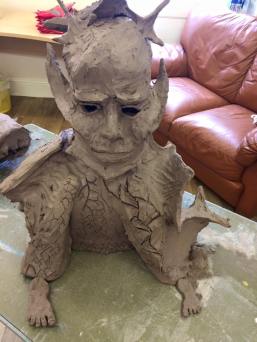
 This bio-morphic head is being built on a clay armature with the techniques described in How to Make a Head. I use coils attached in exactly the same way as I would on a pot to get excellent joins. The coil is then pinched in the direction I want it to go.

28.This bio-morphic head is being built on a clay armature with the techniques described in How to Make a Head. I use coils attached in exactly the same way as I would on a pot to get excellent joins. The coil is then pinched in the direction I want it to go.

Using Supports.

When you are making complicated shapes use temporary supports made of clay that will shrink with the form. Build in support walls and buttresses. Use rigid supports with care: plan to accommodate the shrinkage.

Here I am putting down the first layers of 2 big sculptures. I am using Coleford brick clay in a very soft state. My 'coils' are half bag blocks but they are applied and treated in the same way as any good coil. The walls are thicker at the base to support the considerable weight of the next layers. The internal support-walls are thinner. On very big sculptures these support walls will be discarded when the sculpture is cut into sections. On medium sized sculptures, that will be cut into parts not panels, the internal support walls will be left in to maintain the shapes during firing.

29.Here I am putting down the first layers of 2 big sculptures.
I am using Coleford brick clay in a very soft state. My ‘coils’ are half bag blocks but they are applied and treated in the same way as any good coil.
The walls are thicker at the base to support the considerable weight of the next layers.
The internal support-walls are thinner.
On very big sculptures these support walls will be discarded when the sculpture is cut into sections.
On medium sized sculptures, that will be cut into parts not panels, the internal support walls will be left in to maintain the shapes of the sections during firing.

30.Note the finger marks left by the process: these are just like the marks of a serrated-kidney on a smaller pot. Like corrugation, they add strength to the wet clay wall and will be left on until the clay is firm enough to hold it’s shape.


The same layer of the fired panel-sections of the same sculpture during installation.

The same layer of the fired panel-sections of Bruce during installation.

Bruce in progress. There is a clay support wall under his head and the stack of blokes.

31.Bruce in progress, 3m wide x 2 m high. There is a clay support wall under his head and the stack of blocks was added later and removed as soon as the head was firm enough to cut apart.

Here’s some good examples of rigid supports in action:

Mynydd Mawr Courtyard Sculpture, Tumble, Carmarthen, Wales, 2m H x 190cm W.

32.  Mynydd Mawr Courtyard Sculpture, Tumble, Carmarthen, Wales, 2m H x 190cm W. The big blocks are firm memory foam which will accommodate the shrinkage. I often use it inside a piece to support ceilings. It gets removed when the piece is cut up.

Rebecca Buck, Osprey Studios.

33.Because this rigid support leans outwards it will not constrict the shrinkage. It was adjusted repeatedly during the build.

Mynydd Mawr, Tumble, nearly complete. Larger sculptures are always built from a scale model. The internal support walls are worked out in advance and the cutting of sections planned so that those walls will support the section's shape during firing.

34.Mynydd Mawr, Tumble, nearly complete. Larger sculptures are always built from a scale model. The internal support walls are worked out in advance and the cutting of sections planned so that those walls will support the section’s shape during firing.

front view. That broom was a good buy.

front view. That broom was a good buy.

Balarat Pit Marker,in progress, 6m L x 2m H.

35.Balarat Pit Marker,in progress, 6m L x 2m H. ( Ocean Colliery Pit Marker in background.) Memory foam on top of clay support walls inside the sculpture supports that long roof and accommodates the shrinkage.

The Sirhowy Wyvern in progress, 3m L x 2 m H. A tunnel runs under the horse with carved images on it's walls so we needed access to it. A thin support wall blocks the tunnel half way. It supports the structure but allows us to crawl in do the art-work ( a lot was done by some fab children) The support was discarded when we cut the sections. We didn't get to see the tunnel right through until it was installed on site.

36.The Sirhowy Wyvern in progress, 3m L x 2 m H. A tunnel runs under the horse with carved images on it’s walls so we needed access to it. A thin support wall blocks the tunnel half way. It supports the structure but allows us to crawl in do the art-work ( a lot was done by some fab children) The support was discarded when we cut the sections. We didn’t get to see the tunnel right through until it was installed on site.

Bucket and stool supporting the tunnel roof while we built it. The board to the left of the picture is there to protect some intricate carving about the Sirhowy Iron Works during the build.

37.Bucket and stool supporting the tunnel roof while we built it. The board to the left of the picture is there to protect some intricate carving about the Sirhowy Iron Works during the build.

Adding clay on to the surface.

38.All the big coiled sculptures have artwork added onto the surface once it is firm. Exactly like the smaller pot, the area is softened using scored ‘ditches’ and slip to hold the water in place, allowing it to soak in to the firm clay and raise up those platelet shaped clay particles ready to join with soft clay.

Once a good join is achieved the added clay is modelled and carved in stages as the clay firms up. The drying ( and shrinking) is kept slow using plastic covers to allow that vulnerable join to set as the water moves from the soft added clay into the firm wall.

Remember that water will always want to be level and will travel down the form over time as well as evaporating from the surface. This passage of water past those platelets completes the join. If there is too much water it will collect and run down  the join, destroying the bond.

With that in mind add as much clay as your artwork needs. If it becomes more that 2 cm thick hollow it from the inside even if this means cutting the section out of the form, hollowing it and reassembling it. The important thing is to find a way to get the look you want. For advice on this process click here: Working solid and hollowing sections out.

Drying coil-built forms.

39.Use plastic to shield firm parts from drying while you work on new parts. e.g. a strip of plastic sheet to keep the top edge soft while you put art-work on a lower area before it gets to hard. And visa-versa.

Slow the drying as much as possible to allow all those joins to set using plastic sheets.

Cover the piece in a shield of newspaper ( 5 sheets thick) or a cardboard box or fabric sheets (not wet) to create a  damp micro-climate that will slowly release the water from the clay and protect from drafts that would cause un-even drying (and maybe, consequently, cracking)


Related info on this site.

For a full description of how the really big sculptures are done click here: Building Brick Sculptures on a monumental scale.

The whole story of the fab Gwalia Mynydd Mawr Care and Nursing Home Courtyard Sculpture designed with local primary school children and staff and residents of the Home, run by Arts Care Gofal Celf in Carmarthen, Wales: Studio Diary, The Tumble Commission, parts 1-8. 

Using clay armatures and coils: How to Make a Head: Clay Armatures and Building Hollow.

Questions?

put your questions in the Comments below and I will do my best to answer them.

If you follow this site you will get an e-mail each time I put up a new post. I hope these ‘How to..’ posts are useful. Pass them on freely. Share pictures of what you make  on my Facebook. I would love to see it.


How to Make Abstract Sculpture in Clay; working solid and hollowing out.


Over Half a Century III.

Half a Century VIII.

The Edge VII

Wyvern VIII, 2015, 39cm H x 71cm L x 34cm D, ceramic.

Up is Down VII, back view

Up is Down V, 44cm H x 58cm L x 50cm D,

Up is Down VI, second view.

Up is Down V, back view

Making Abstract Sculpture can feel very elusive; where to start, when to stop? This post aims to de-mystify the process and give you an ideal technique that will allow you to go with your flow to make beautiful Abstract forms that express those things that are not easily put into words or naturalistic art.

Because there is no right or wrong with Abstracts you are better off with a technique that allows you to feel your way around the form and to change your mind any time you want to. Building the piece in solid clay allows you to separate the ceramic-technical needs from the flow of creativity for the most part. You do need to make good joins as you go along but with the right clay that is not a distraction. It’s a great method for pieces up to 1 metre. For larger Sculptures I often use it over a hollow clay-armature to reduce the over-all weight. Use a clay designed for sculpture and hand-building with plenty of grog (gritty bits like sand). Scarva’s ES 50 is fab and excellent value for money.

I work to music and usually have a theme I am following.  When you start out with Abstracts you need to put some boundaries in place; have a theme (an emotion, geometry, etc) or abstract a known form like a figure or an animal. All the pieces above were made using this technique. All but one are made in combinations of Scarva’s black clays.

Gill Tennant-Eyles, Emma Bevan and Tez Roberts came to Osprey Studios for a Workshop. We had an excellent day going over this technique and sharing each other’s ideas.

Make a block of clay that has the approximate hight/width/depth you feel you need at this point. Rough out the beginnings of a form.

Make a block of clay that has the approximate hight/width/depth you feel you need at this point. Rough out the beginnings of a form.

Work all around the form in stages, giving each area equal attention, refining with each rotation.

Work all around the form in stages, giving each area equal attention, refining with each rotation.

Add or subtract clay. A paddle will be very useful.

Add or subtract clay. A paddle will be very useful.

When the piece starts sagging leave it to harden up a bit. Use plastic to keep the drying even.

When the piece starts sagging leave it to harden up a bit. Use plastic to keep the drying even.

For larger pieces the process is the same. Use props or leave temporary supports of clay to hold up the form until it hardens. These might stay there until you have hollowed out the sculpture and reduced the weight.

OLYMPUS DIGITAL CAMERAOLYMPUS DIGITAL CAMERAOLYMPUS DIGITAL CAMERA

Once the piece is leather-hard carve/scrape the surface. You can still add clay but pay attention to the joins.

Once the piece is leather-hard carve/scrape the surface. You can still add clay but pay attention to the joins.

At the point where the form is complete apart from finishing the surface stop building and get ready to hollow -out. The piece should be firm enough to resist a thumb-print. On very large pieces you might start hollowing the top while the lower parts are still too damp; the hollowed clay walls will need to be able to support themselves with-out distorting. Don't let the form get to hard or you wont be able to cut it open.

At the point where the form is complete apart from finishing the surface, stop building and get ready to hollow-out. The piece should be firm enough to resist a thumb-print. On very large pieces you might start hollowing the top while the lower parts are still too damp; the hollowed clay walls will need to be able to support themselves with-out distorting. Don’t let the form get too hard or you wont be able to cut it open.

How thick the clay can be to fire well depends on the amount of grog, the denseness of your modelling style, drying time and the speed of your firing.

Air bubbles trapped in the clay will expand with the heat. Grog and/or a loose surface will allow the air to seep through the clay. The same is true with water but steam expands fast. If your piece breaks into big bits during the fire it was trapped air and you will be able to see where the bubbles were in the shards. If it blows up into a trillion smithereens it wasn’t properly dry!

I dry thick sculptures slowly under plastic which I turn daily for 4 weeks minimum and then 1-2 weeks in a plastic tent with a dehumidifier. A long dry allows the water to level out as water loves to do and that will enhance the structure of the clay within it’s new sculpture shape. You will get less cracks or distorting in the fire.

I fire very slowly with an 18 degree C rise until 600 degrees C.

Generally 3cm is a fair maximum thickness for a well grogged clay.

Choosing where to cut is easy: Starting at the top make the first cut at the point where you can  reach all the parts that need hollowing to leave 1-3cm walls. That may mean cutting off a very small piece and hollowing barely a few scoops, for example the head of a figure: drill a tool down the neck and then your next cut would be low on the chest, etc. Always ensure there is an air outlet for each hollowed area. Hard to reach areas can be skewerd from the inside or outside to make channels for the air/water to escape.

Horizontal cuts are best because gravity is on your side while the piece is drying.

Horizontal cuts are best because gravity is on your side while the piece is drying. Lay the cut section on foam.

Hollow the cut section first, score the edges with a serrated kidney (NEVER make deep scores) moisten w/ water and /or slip so that that edge can soften while the section is upside-down. The hollow into the rest of the form going as far as you can reach. Mark how far you reached on the surface to help you decide where to make the next cut.

Hollow the cut section first, leaving a wall approx 1.5-2cm thick. Do not smooth this inner surface: it will make it difficult for any trapped air to pass through the clay during firing. You can leave ‘buttress’ type support walls. Score the edges with a serrated kidney (NEVER make deep scores with a pointy tool. Tiny bubbles of air will get trapped there all along your join and possibly cause a crack.) Moisten w/ water/slip so that the edge can soften while the section is upside-down. Then hollow into the rest of the form going as far as you can reach. Mark how far you reached on the surface to help you decide where to make the next cut.


Once both edges are softened put the pieces back together and move back and forth until you feel the edges lock together. Genuine joins are formed when the chains of platelet-shaped particles from each section inter-lock. Picture a magnified image of hair. Score marks do not give the surface 'tooth'; they allow water into the clay-body. On vertical surfaces they hold the water in place to give it time to sink in. Slip is not 'glue', it is clay particles spread out in water and has little strength, especially when it has dried. It is ideal for holding a lot of water in place to give it time to be absorbed to soften the area of leather-hard clay. Manipulate the softened clay at the join to encourge further integration of those particle-chains and to disturb the straight line of the join; cracks love to zing along a nice straight slip-weakened join during the firing when the pull of shrinking stresses the sculpture.

Quality Joints:  Once both edges are softened put the pieces back together and move back and forth until you feel the edges lock together. Genuine joins are formed when the chains of platelet-shaped particles from each section inter-lock. Picture a magnified image of hair. Score marks do not give the surface ‘tooth’; they allow water into the clay-body. On vertical surfaces they hold the water in place to give it time to sink in. Slip is not ‘glue’, it is clay particles spread out in water and has little strength, especially when it has dried. It is ideal for holding a lot of water in place to give it time to be absorbed to soften the area of leather-hard clay.                                         Once both edges are softened put the pieces back together and move back and forth until you feel the edges lock together.        
Manipulate the softened clay at the join to encourage further integration of those particle-chains and to disturb the straight line of the join; cracks love to zing along a nice straight slip-weakened join during the firing when the pull of shrinking stresses the sculpture.


Smooth the now recessed join with water + rub until a slip is lifted from the join's surface. Make a coil 1.5cm thick by squeezing. Do not roll your coils; it packs the finer particles on the coils's surface making it resistant to joining. Attach one end and inch the coil into the join; press in then squeeze the coil to force it to inch forward along the join; this friction creates the bond.

Smooth the now recessed join with water + rub until a slip is lifted from the join’s surface. Make a coil 1.5cm thick by squeezing. Do not roll your coils; it packs the finer particles on the coils’s surface making them resistant to joining. Attach one end and inch the coil into the join; press in then squeeze the coil to force it to inch forward along the join; this friction creates the bond between the surfaces. Coiling explained here.

Blend the coil in, leaving it raised. The excess clay will slowly release it's water into the join, slowing drying. Wrap the piece in plastic and leave for week or so until the coil has the same hardness as the rest of the form. Then you can scrape it away, compressing the clay as you go to leave a strong join that wont recess during the firing.

Blend the coil in, leaving it raised. The excess clay will slowly release it’s water into the join, slowing drying. Wrap the piece in plastic and leave for week or so until the coil has the same hardness as the rest of the form. Then you can scrape it away, compressing the clay as you go to leave a strong join that wont recess during the firing.

Make you next cut and repeat.

Make your next cut and repeat.

Once those coils have hardened under plastic you can complete the Sculptures surface and edges.Once those coils have hardened under plastic you can complete the Sculptures surface and edges. Then set to dry very slowly (min 4 weeks) under a 5-sheets-thick-newspaper or cardboard box. For very large forms you can use a double layer of bed-sheets. If you use plastic turn it regularly so that condensation doesn't drip onto the clay and spoil it.

Once those coils have hardened under plastic you can complete the Sculpture’s surface and edges.   Then set to dry very slowly (min 4 weeks) under a 5-sheets-thick-newspaper or cardboard box. For very large forms you can use a double layer of bed-sheets. If you use plastic turn it regularly so that condensation doesn’t drip onto the clay and spoil it. Or stick plastic over your selves to make a micro drying-room.

Work in progress by Gill Tennant-Eyles

OLYMPUS DIGITAL CAMERA

Work in progress by Emma Bevan

OLYMPUS DIGITAL CAMERA

Work in progress by Tez Roberts

OLYMPUS DIGITAL CAMERA

These sculptures were all made with this excellent, versatile technique.

The Edge VIII, in progress.

The Edge VIII, in progress.

Up Is Down IV, in progress.

Up Is Down IV, in progress.

Up Is Down II, in progress.

Up Is Down II, in progress.

Up Is Down V, in progress.

Up Is Down V, in progress.

Up Is Down X, in progress.

Up Is Down X, in progress.

Over Half a Century, in progress.

Over Half a Century, in progress.

Wyvern VIII, in progress.

Wyvern VIII, in progress.


What Was the First Abstract Artwork?

click on this title to see the original article. Artsy has some really interesting reviews and is a great place to see stunning art-work.

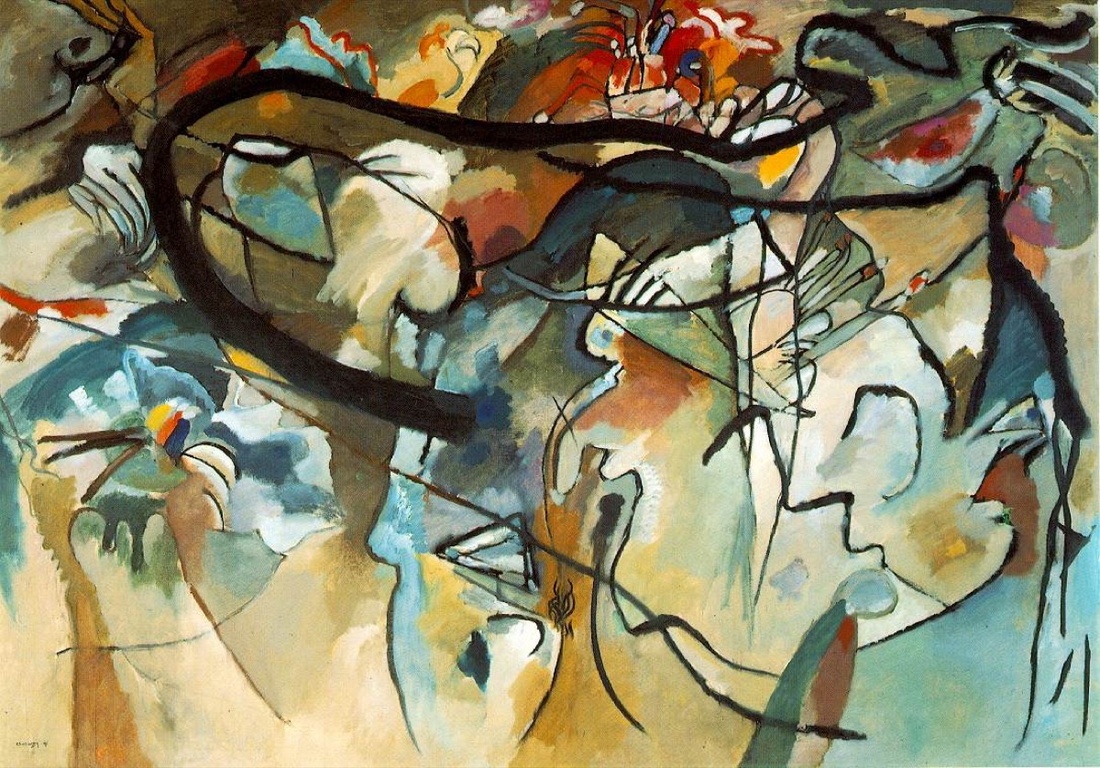
  • Wassily Kandinsky, Composition V, 1911. Image via Wikimedia Commons.

Who made the first Western abstract painting? That was the question that Wassily Kandinsky’s widow, accompanied by a team of researchers, set out to answer in 1946. Her late husband, a Russian painter who was among the pioneers of abstraction in the early 1910s, had himself been personally invested in the answer.

In 1935, Kandinsky had penned a letter to his gallerist in New York to insist on his preeminence. “Indeed,” he wrote of a 1911 work, “it’s the world’s first ever abstract picture, because back then not one single painter was painting in an abstract style. A ‘historic painting’, in other words.”

Kandinsky wasn’t the only artist interested in preserving his legacy. He and several early abstract painters—including Robert Delaunay, Mikhail Larionov, Natalia Goncharova, and Kazimir Malevich—backdated their works, in some cases several years before they were actually completed.

This artistic jostling reflects a focus on invention as an individual act, notes curator Leah Dickerman in an essay for MoMA’s 2012 show “Inventing Abstraction, 1910-1025: How a Radical Idea Changed Modern Art.” But, as she goes on to say, that approach is in some ways misguided. Rather than the work of a solitary genius, abstraction “was an invention with multiple first steps, multiple creators, multiple heralds, and multiple rationales.”

What Makes an Abstract Expressionist Painting Good?

At the turn of the 20th century, the world was becoming increasingly connected. Steamships, cars, and trains facilitated international travel, while telephones, telegraphs, and radios allowed for conversations between people on opposite ends of the globe.

Within the art world specifically, journals sprang up in droves; in Paris alone, some 200 reviews of art and culture appeared in the decade leading up to World War I. Subscribers were scattered across Europe and America, allowing a wide swath of creatives to stay abreast of the latest developments in art. And this period also saw the beginning of a traveling exhibition culture, led by the Italian Futurists.

“Historians talk about ‘conditions of possibility,’” Masha Chlenova, a curator who worked with Dickerman on “Inventing Abstraction,” told Artsy. “For example, photography was also invented by three people at the same time. Daguerre just happened to be the best at marketing and patenting.”

Similarly, while Kandinsky is today hailed as the father of abstract painting, he was by no means the only player in the development of non-representational painting. His work Komposition V did, admittedly, jumpstart public interest in abstract painting. Exhibited in Munich in December 1911, this monumental work was just barely representational.

It was the first such work to be put on display, and “for some artists and intellectuals, abstraction not only began to seem plausible, but also took on the character of an imperative,” Dickerman writes.

Kandinsky had been thinking about abstract art for years beforehand. His manifesto On the Spiritual in Art, which appeared as a draft in 1909 and was published the same month as Komposition V went on display, laid out the tenets of abstraction. But it would still be several years before Kandinsky would finally break free from recognizable forms in his art. As Chlenova put it, “he theorized abstraction before he made painting.”

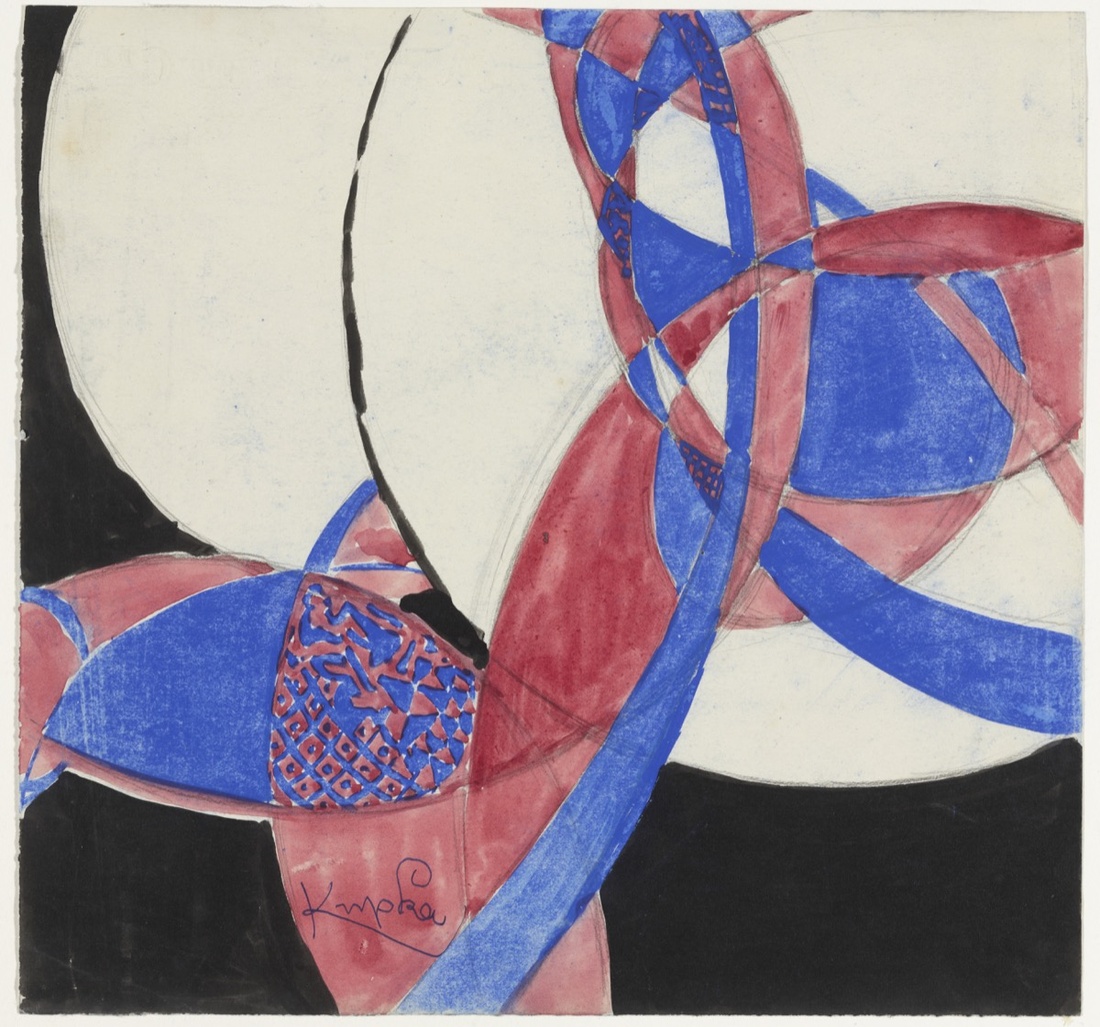
  • František Kupka, Amorpha: Fugue in Two Colors, 1912. Courtesy of The Museum of Modern Art, NY. © 2017 Artists Rights Society (ARS), New York / ADAGP, Paris.
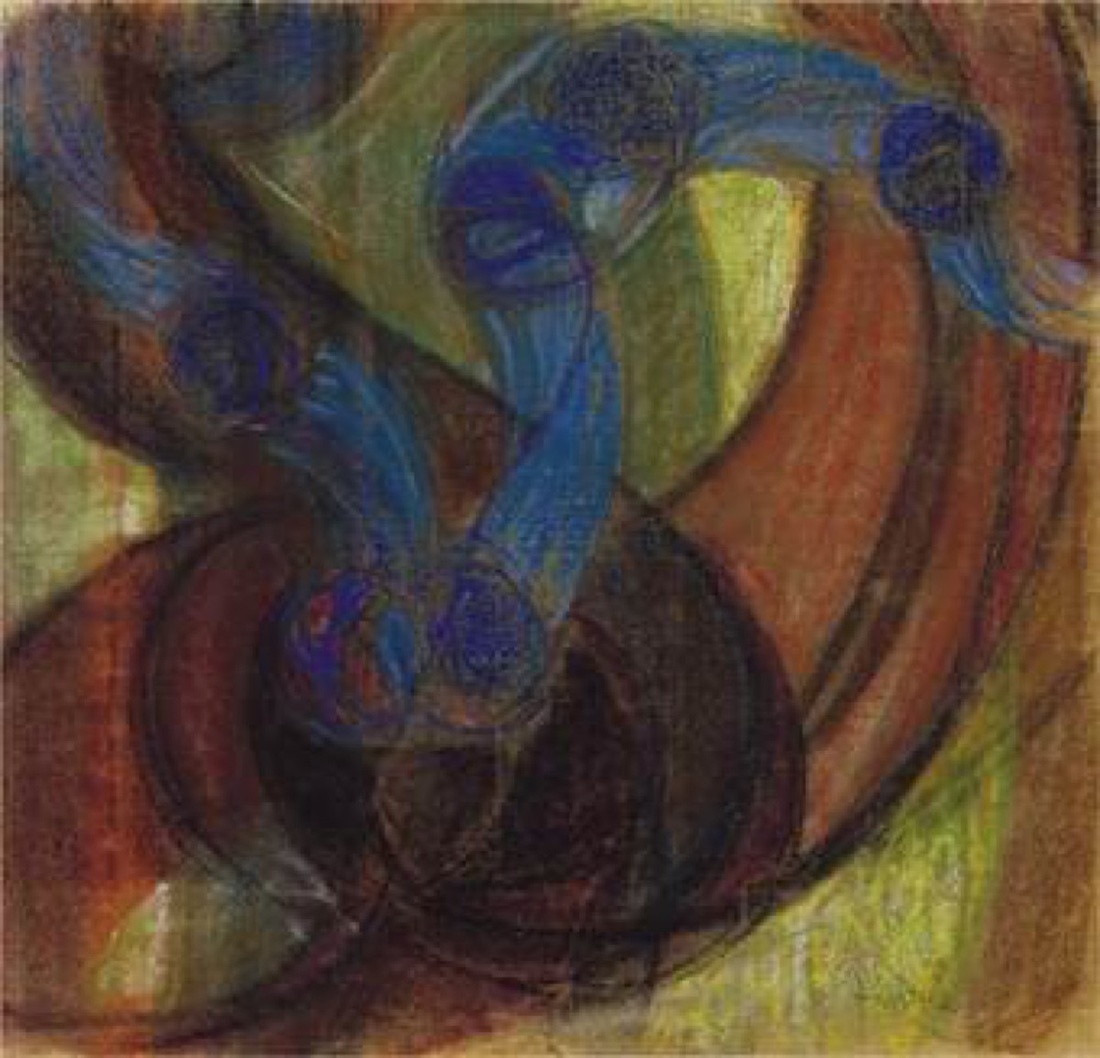
  • František Kupka Study for Amorpha, Warm Chromatic and for Fugue in two colors; Study for The Fugue, 1910–11. The Solomon R. Guggenheim Foundation Peggy Guggenheim Collection, Venice, 1976. © 2017 Artists Rights Society (ARS), New York/ADAGP, Paris.

Dickerman references Czech-born artist František Kupka as the first to display works that were a complete break from representational painting. His compositions Amorpha, Chromatique chaude and Amorpha, Fugue à deux couleurs were shown at the Salon d’Automne in Paris in October 1912, filmed for the newsreels, and then broadcast across Europe and America.

Dickerman believes that Kupka’s willingness to publicly defy convention was related to his personal history. Although he grew up in Prague and Vienna and started out as a Symbolist, he later moved to Paris and developed close ties with the city’s avant-garde—which, as Dickerman notes, granted “him an insider/outsider status that seems particularly fertile for paradigm-shifting thought.”

But further complicating the question of “first” is that it can be difficult to determine the threshold of abstraction. When, precisely, does a work go from “abstracted” to “abstraction”?

French avant-garde artist Francis Picabia, for example, is sometimes credited with the first abstract painting. His watercolor Caoutchouc (Rubber) was completed in 1909, which would predate even Kandinsky’s theories on abstraction. But other academics have pushed back, noting that the work still retains some semblance of form, reminiscent of a bouquet of flowers.

For “Inventing Abstraction,” Chlenova said she and Dickerman began by establishing clear criteria for what they considered abstract work. “Our main criterion was the artist’s own position and their statements that they’re doing something abstract,” she said. “The terminology is a slightly different question because the word ‘abstract’ would not necessarily be used. But there was a very clear awareness from the artists that were sensitive to what was happening.”

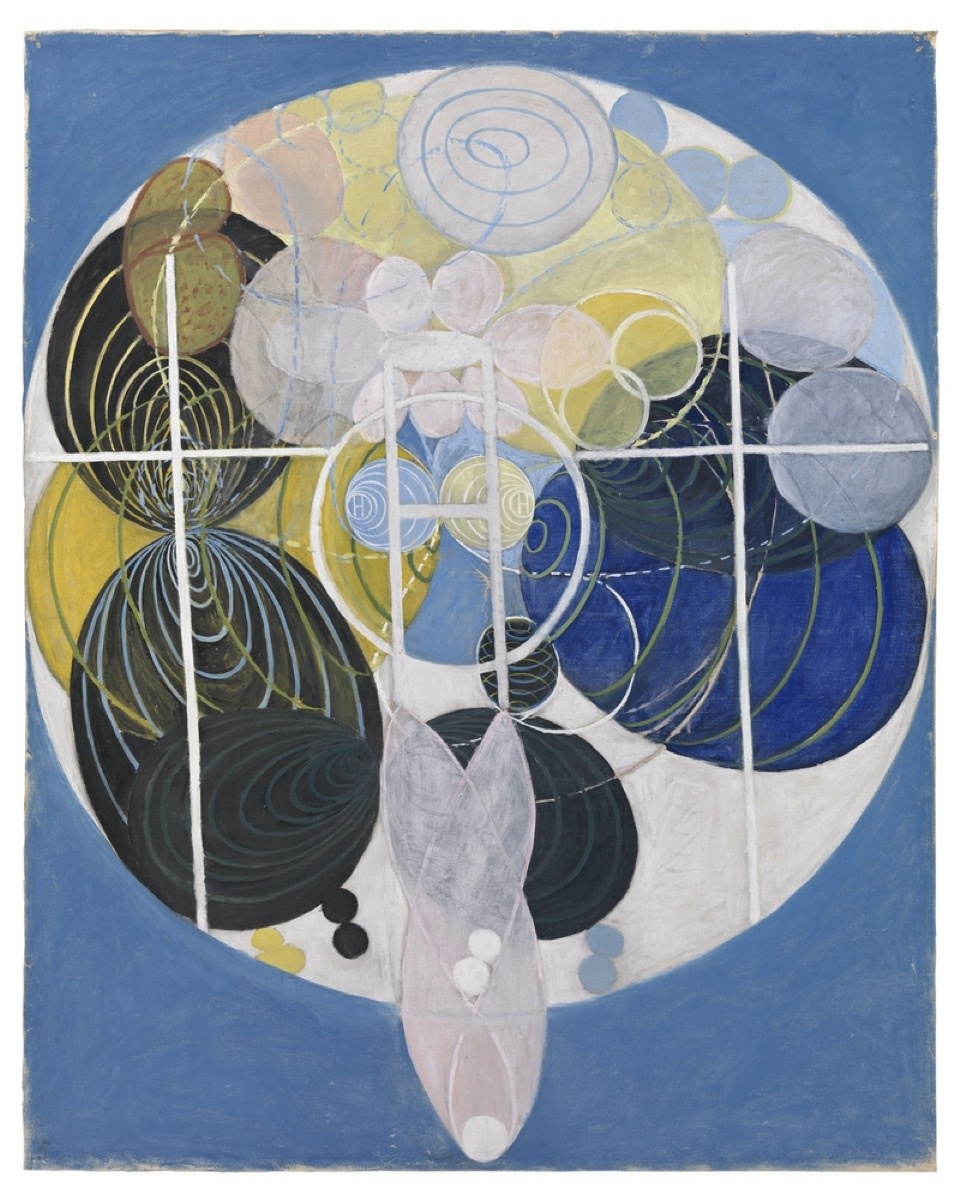
  • Hilma af Klint, The Large Figure Paintings, No. 5, Group III, 1907. Image via Wikimedia Commons.
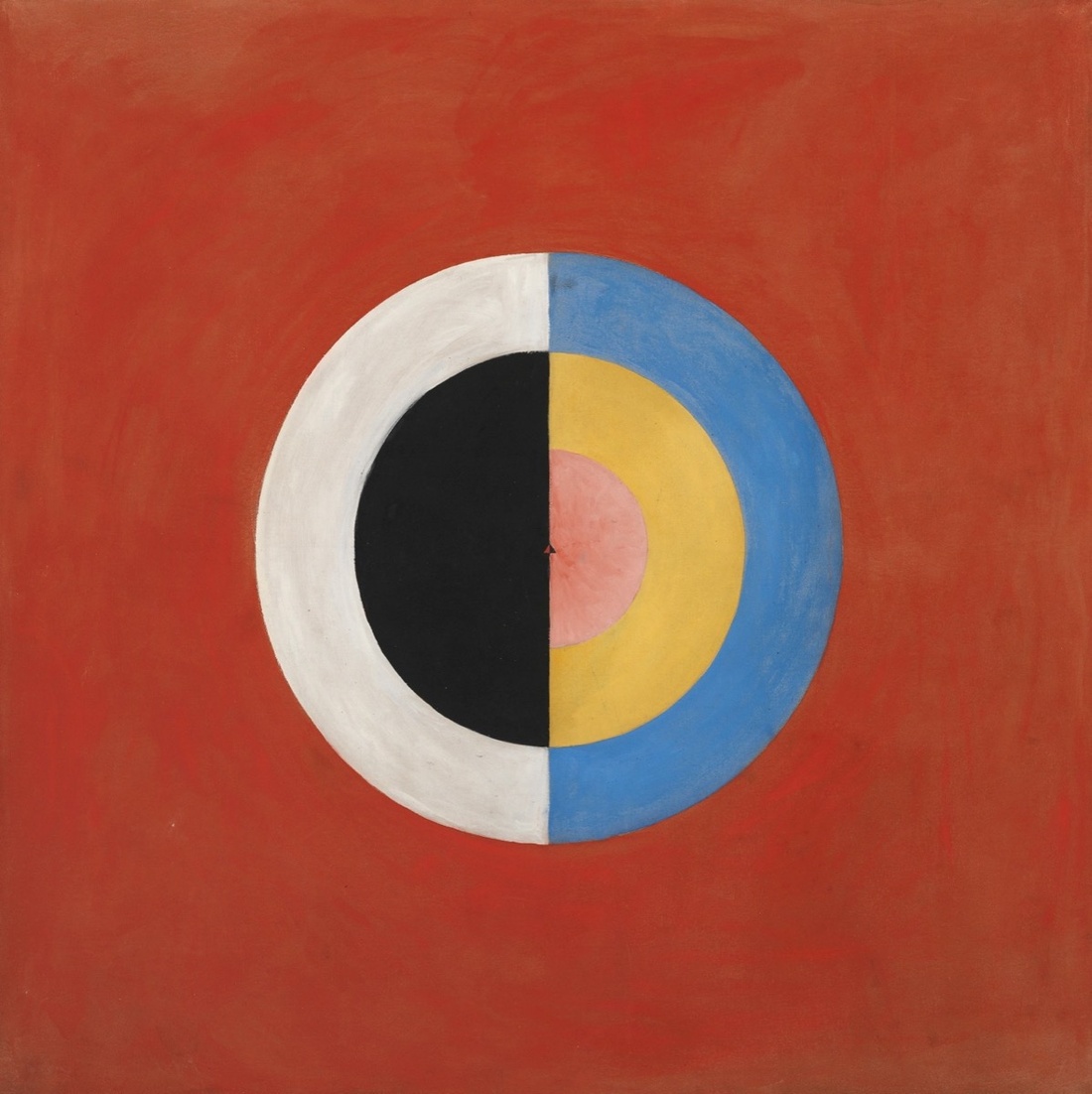
  • Hilma af Klint, Svanen (The Swan) No. 17, Group IX/SUW, The SUW/UW Series, 1914-1915. Image via Wikimedia Commons.

This is why, she explained, Swedish artist Hilma af Klint was not represented in the MoMA exhibition. Since 2013, when Moderna Museetheld the first-ever retrospective of her work, af Klint’s oeuvre has received renewed attention from the public. Known in her lifetime as a landscape painter and portraitist, it was revealed decades after her death that she had also been experimenting with abstraction. As early as 1906, af Klint had been painting colorful works full of organic shapes, spirals, and curlicues.

This date places her several years before Kandinsky even theorized abstraction, let alone acted on his ideas. But af Klint’s works sprang from her interest in the occult—during the 1890s, she started organizing seances with four artist friends where they practiced automatic drawing and writing.

Later, when she began her largest body of non-representational paintings, she claimed that spiritual forces were directing her hand. And for an artist to be included in “Inventing Abstraction,” Chlenova explained, they had to “formulate their practice as a conscious rejection of any reference to the outside world.”

Others disagreed with this reading, arguing that a mystical approach should not negate her contribution to developing abstraction. “‘Spiritual’ is still a very dirty word in the art world,” curator Maurice Tuchman toldthe New York Times in 2013. “When the prejudice against the idea of the spiritual life in af Klint’s work is overcome, which will require scholarship, then perhaps she will really take hold in the broader conversation.”

But there’s no disagreement that the invention of Western abstraction revolutionized art production in the 20th century, nor that it was predated by centuries of abstracted forms and patterns in non-Western traditions.

“One can treat abstraction a little bit more abstractly, if you will,” Chlenova laughed, “without ultimately being too concerned about who was first.”

—Abigail Cain

Studio Diary; The Landscape Project, part 6, Review so far…

It’s the end of the 1st year and time to take stock. You can see the earlier parts of the story via the Contents page. Click on any picture to see it full size.

Stephen Foote and I met up after 30 years. We were good friends as teenagers, both rather disengaged with school, both making art in our own time. 30 years on we both still use art work as a major part of our interaction with this nutty world. Sharing our images was a key way we got to know each other again and harnessing that process in a joint project was simply a way of capturing a what was occurring naturally. We set a straightforward ” Artist Responds to Landscape ” brief and kept a very open mind while we walked, talked, Steve took pictures and I just took it all in. We met every few months and sent each other pictures of the ensuing work in-between times.

Steve is also a Cameraman and was involved in filming for Panorama during the early, very heated phase in Kiev and the Crimea. I was coming to the end of the Up Is Down Series . Our first visit was Bracelet Bay, Mumbles, Swansea. Then we went into Porth Yr Ogof caves and had a mind-blowing day for me; we spent hours in the dark, natural cave while Steve took a fab series of photographs. I stood in the river in the darkness, held the lights and listened to the flow of water, felt the under-ground breezes. From there the project clarified for us as the travels of the water from the sky above the Brecon Beacons to the river, especially the Tawe, down to the wide bay at Swansea, and out into the Ocean where much of it will return to the clouds and begin the circle again.

These pictures are roughly in sequence for the progression of work over the last year with Steve’s Photos next to the related Sculptures.

Bracelet Bay , Stephen Foote.

Bracelet Bay , Stephen Foote.

Up Is Down- in progress

Up Is Down- in progress

10003791_10203331962960554_1179723863_o


Up Is Down- in progress

Up Is Down- in progress

Up is Down IX, 57cm W,

Up is Down IX, 57cm W,

Stephen Foote; Dunes

Stephen Foote; Dunes

Bracelet Bay, Mumbles, Swansea by Steve Foote

Bracelet Bay, Mumbles, Swansea by Steve Foote

in progress, July 2014

in progress, July 2014

Bracelet Bay, Mumbles, Swansea by Steve Foote

Bracelet Bay, Mumbles, Swansea by Steve Foote

in progress August 2014

in progress August 2014

Bracelet Bay, Mumbles, Swansea by Steve Foote.

Bracelet Bay, Mumbles, Swansea by Steve Foote.

It was this fabulous picture that shifted me abruptly into figures, much to my own surprise.

Busts in progress, Aug 2014.

Busts in progress, Aug 2014.

Bracelet Bay, Mumbles, Swansea by Steve Foote

Bracelet Bay, Mumbles, Swansea by Steve Foote

OLYMPUS DIGITAL CAMERA


A narrative developed that was also influenced by the awesome storms of the previous winter. A trio of figures, the Guardians of the Aquasphere, the Lithosphere and the Atmosphere, arose and they and their Harbingers took on characteristics that the  many life-forms of the Biosphere could relate to so that all would understand what was happening; The Triumvirate were going to let loose their forces. This was not to threaten or  punish. They simply knew it was time.


Brecon Beacons, by Steve Foote.

Brecon Beacons, by Steve Foote.

OLYMPUS DIGITAL CAMERA The Atmosphere in the form of an Osprey.


Porth Yr Ogof Cave, Brecon Beacons, by Stephen Foote.2014

Porth Yr Ogof Cave, Brecon Beacons, by Stephen Foote.2014


OLYMPUS DIGITAL CAMERA

Guardian of the Atmosphere, The Osprey


The Wyvern and the Osprey, 2014.

The Wyvern and the Osprey, 2014.

OLYMPUS DIGITAL CAMERA

The Wyvern, Guardian of the Lithosphere.


Frame-works for The Wyvern IV and, in the back ground, The Leviathan.

Frame-works for The Wyvern IV and, in the back ground, The Leviathan.

The Lithosphere has The Wyvern, a dragon that has taken a number of forms so far.

The Leviathan in progress, Sept 2014.

The Leviathan in progress, Sept 2014.

The Wyvern and The  Leviathan. in progress, Sept 2014.

The Wyvern and The Leviathan. in progress, Sept 2014.

_F146711

_F147762

OLYMPUS DIGITAL CAMERA

The Wyvern.

1981984_10203331966200635_1180227792_n

Bracelet Bay, Stephen Foote.

OLYMPUS DIGITAL CAMERA

The Wyvern.

_F147928

Bracelet Bay, Stephen Foote.

OLYMPUS DIGITAL CAMERA

The Wyvern.

_F147916 _F147712

OLYMPUS DIGITAL CAMERA

Osprey.

OLYMPUS DIGITAL CAMERA

Wyvern

_1020883

OLYMPUS DIGITAL CAMERA

Leviathon

_F147947

OLYMPUS DIGITAL CAMERA Osprey.

OLYMPUS DIGITAL CAMERA

Leviathon

OLYMPUS DIGITAL CAMERA

Wyvern.

OLYMPUS DIGITAL CAMERA

Wyvern

OLYMPUS DIGITAL CAMERA

Wyvern

The Guardian of the Aquasphere took on the form of the Mountain Ponies that run free in the Beacons.OLYMPUS DIGITAL CAMERA _F148186 _F148023 _F148792 _F148797 OLYMPUS DIGITAL CAMERA   _F147964   OLYMPUS DIGITAL CAMERA OLYMPUS DIGITAL CAMERA _F148811   _F148835  _F148822   _F148837

It has been a fantastic year in the Studio; I am harnessing the narrative and collective sides of the monumental Community Sculptures of the last 13 years. But I’m free to use any scale. The architectural clays I use have given me the freedom to go anywhere in space. My amazing collection of Sculptor and Ceramist friends, from all over the world, on Facebook have encouraged and inspired me enormously. I’m settled into my lovely big Studio ( and gotten over the shock of having it at last!). Stephen and I communicate very well and we egg each other on.

Many thanks to everyone who has visited the work over this last 6 weeks and given invaluable advice and feed-back.I will continue with this series of sculptures until it is done.

We will start a new project focussing specifically on the passage of water from the mountains to the ocean along the  Tawe Valley. We are partnering with some Public art venues and setting up some Community participation to widen our perspective. We will  visit  a small Coal-mine and the Open-cast mine. Only a few years ago, on the 15th of September 2011, 4 men were killed in a dreadful accident at Gleision Colliery when their mine was inundated with water. Making the Pit Markers in Blaengarw, I heard about these type of accidents but, like everyone else, I never thought such a thing could happen here, in this century. From just below the Studio down-wards the River has an extra-ordinary history in the Industrial Revolution.

Neither of us have any idea where this will lead. We feel confident that we have something with substance and a great deal of potential and we have found a work-method that is productive and sustainable. I know from past projects that the community will come up with all sorts of treasures that will lead us into work that is far richer and more interesting than we would make alone. We will trade Workshops in photography and ceramics for input from community groups and individuals. It will be a fun process. We need images, stories, myths, legends,  history-including the ancient history and favourite,  special spots on the river or tributaries.