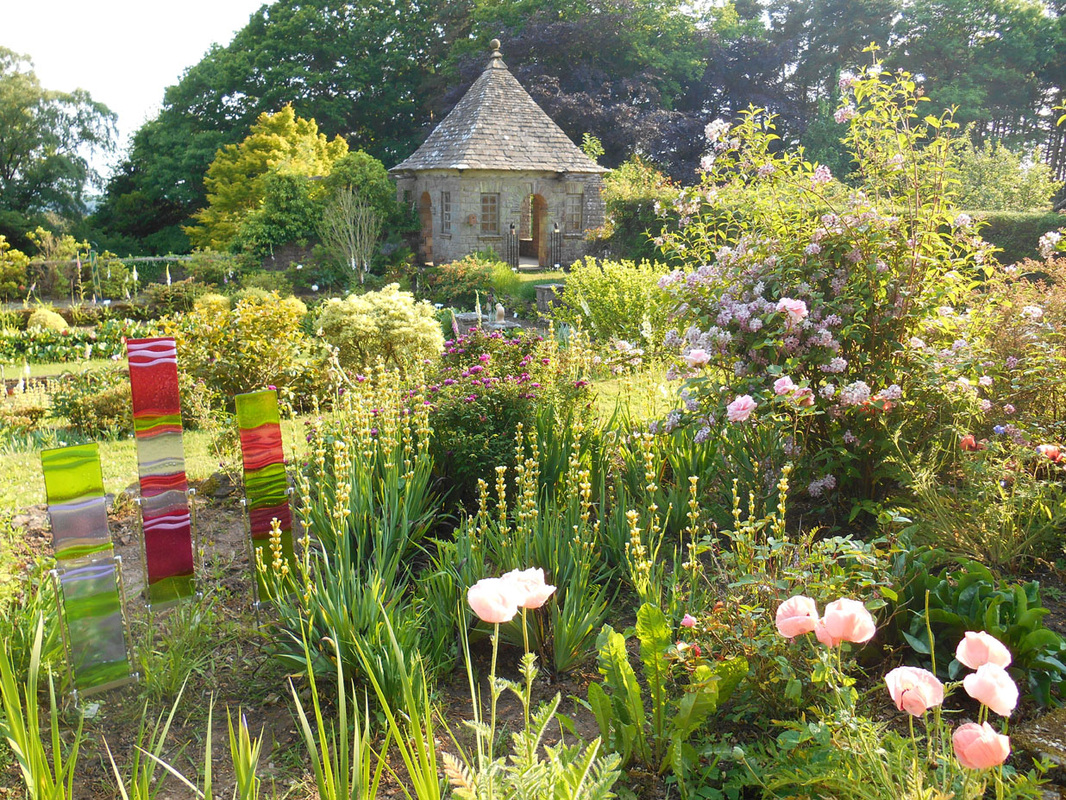
Sculpture in the Garden

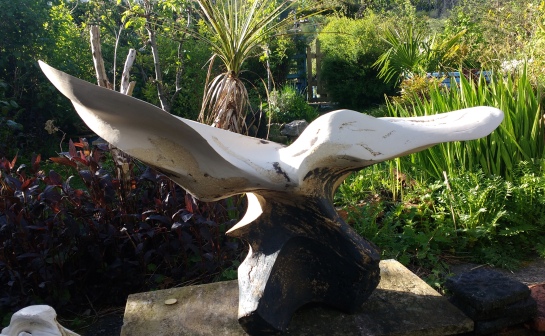
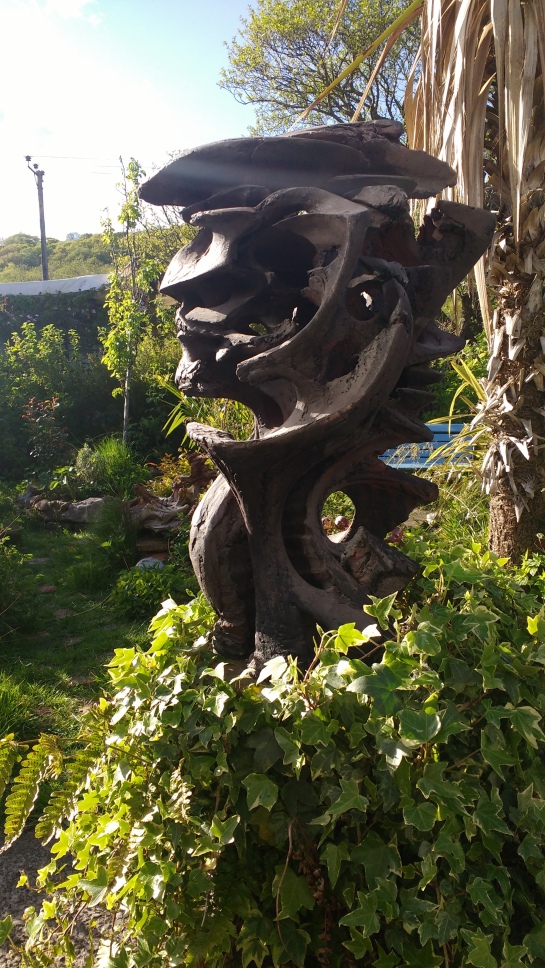
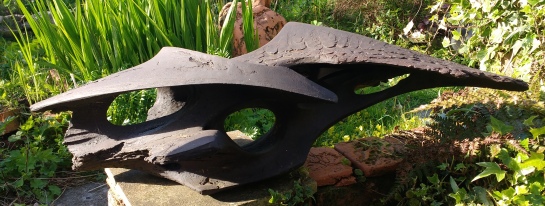
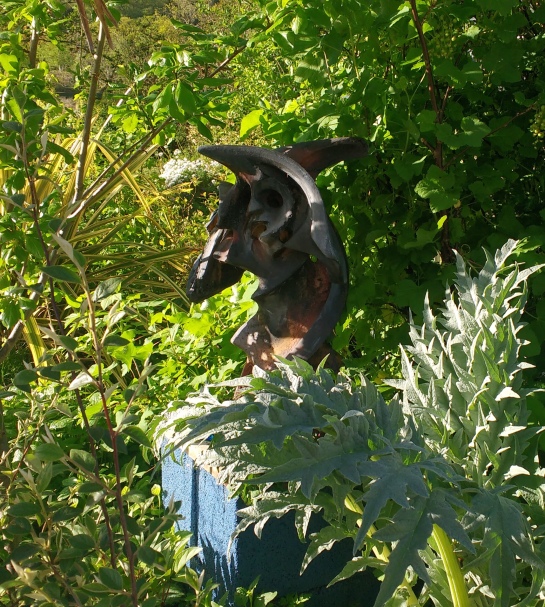
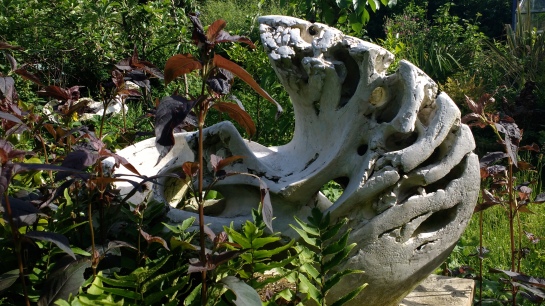
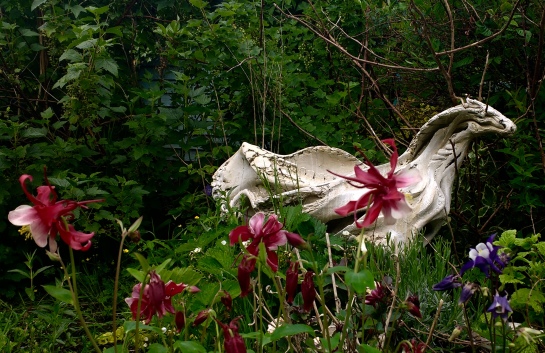
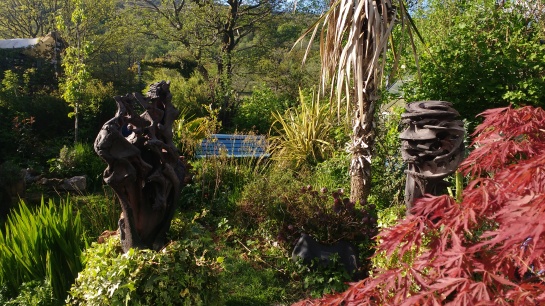
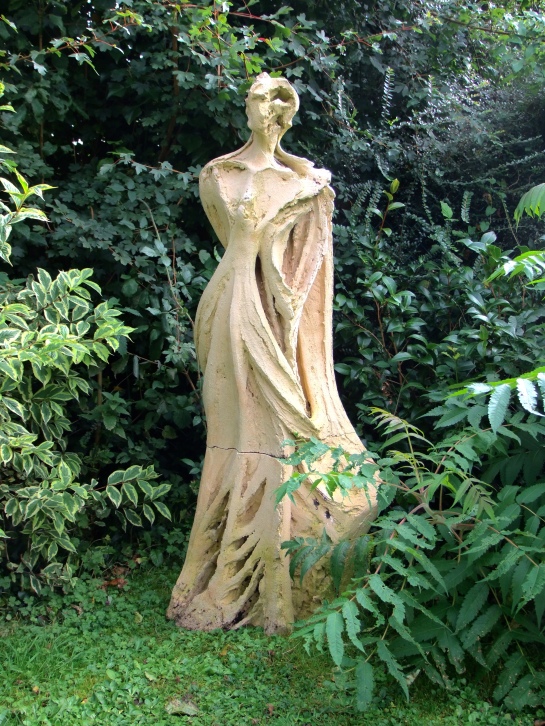
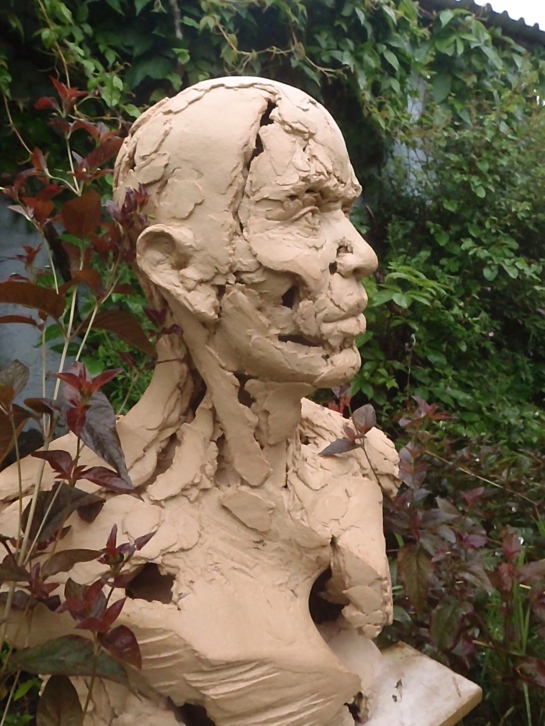
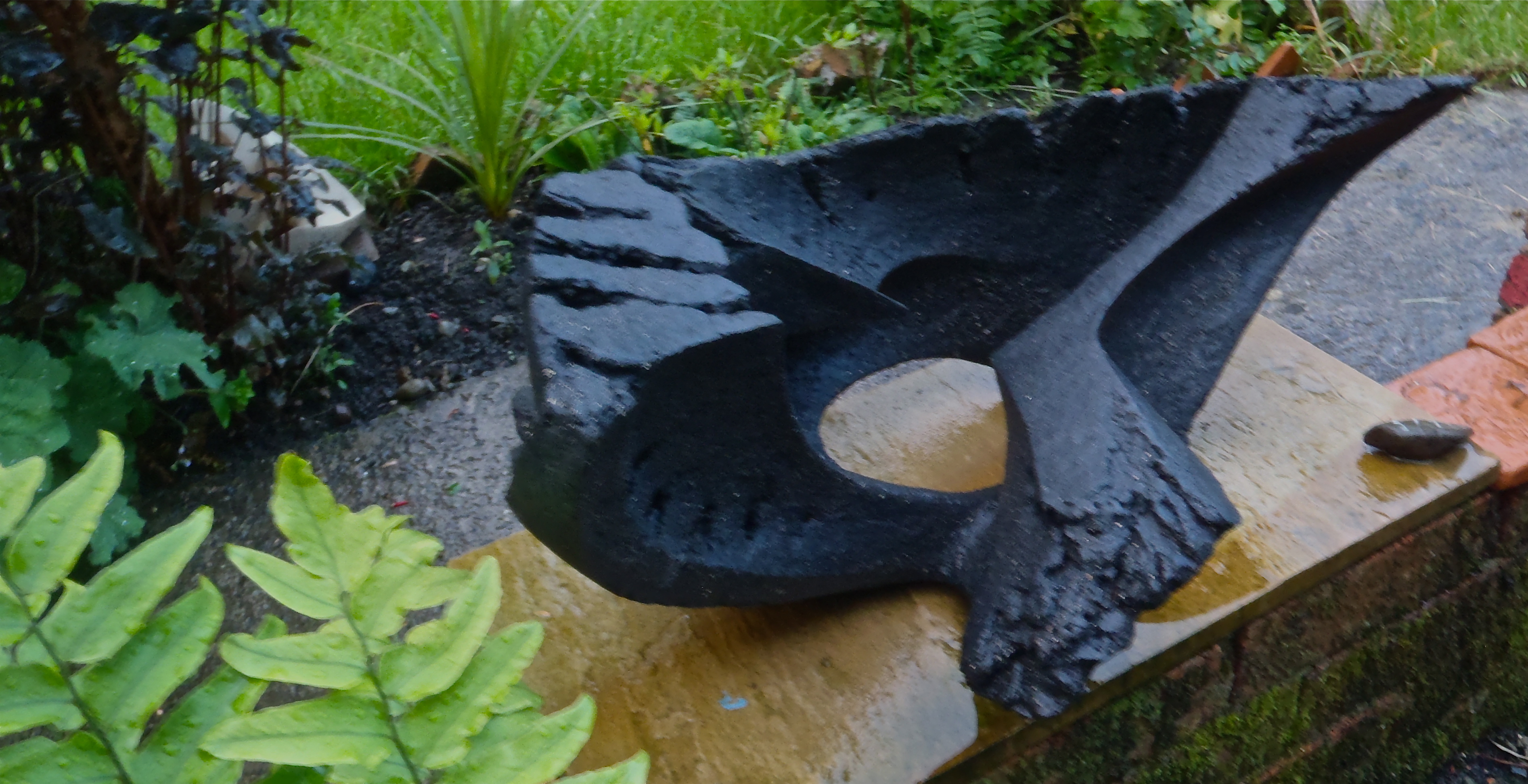
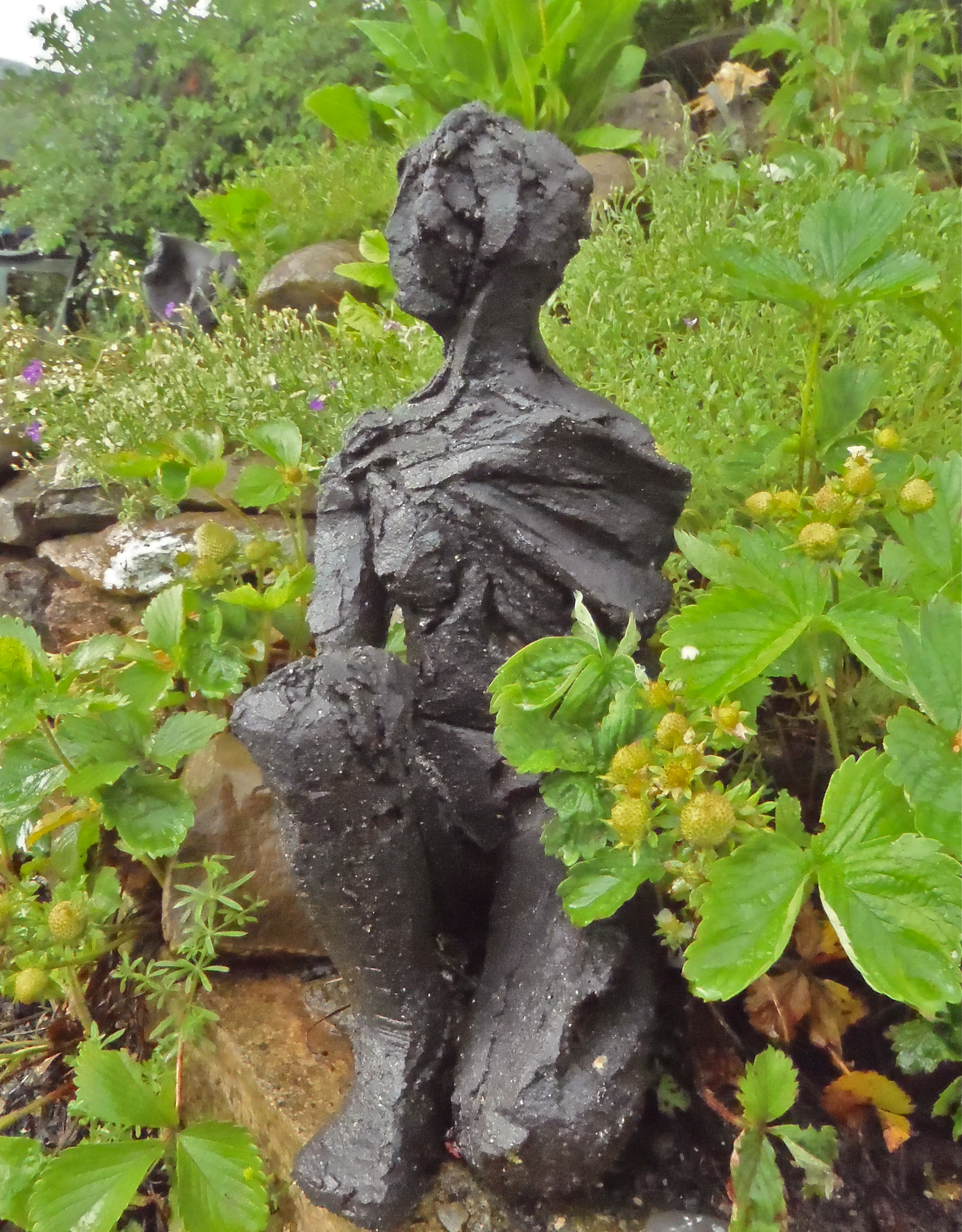
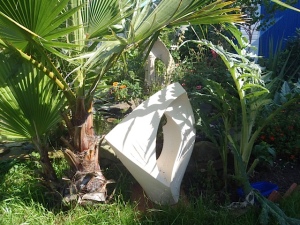
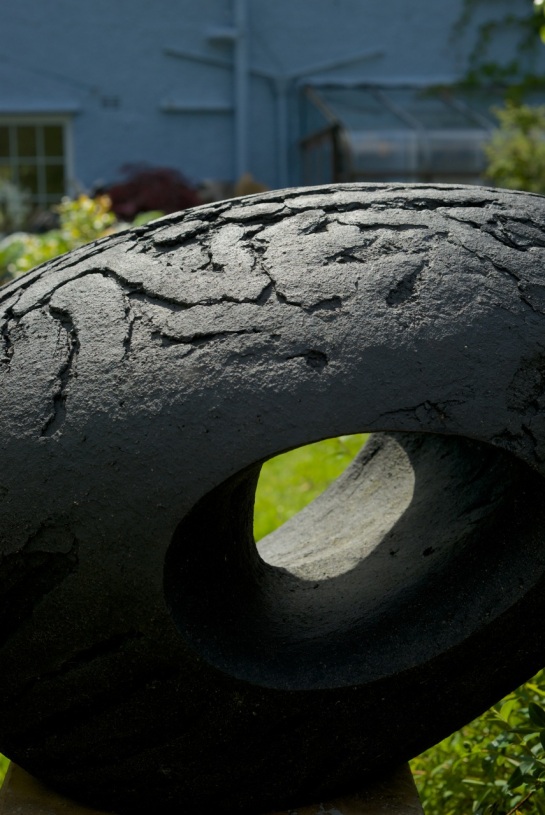
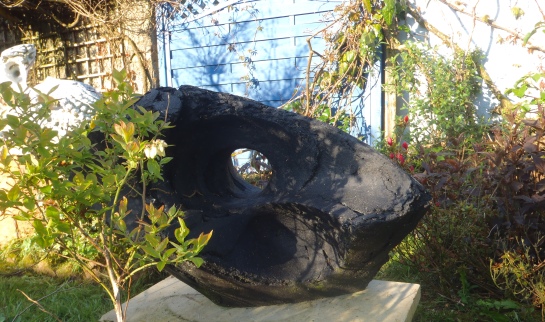
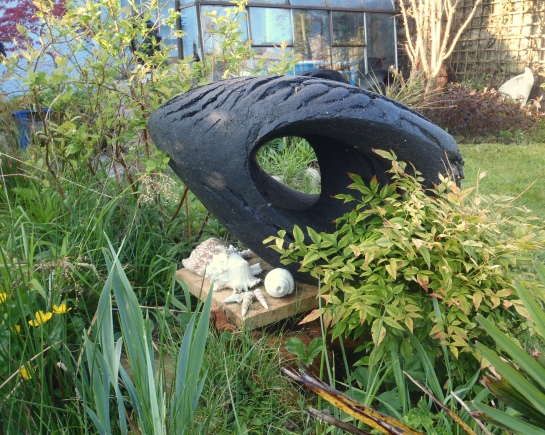
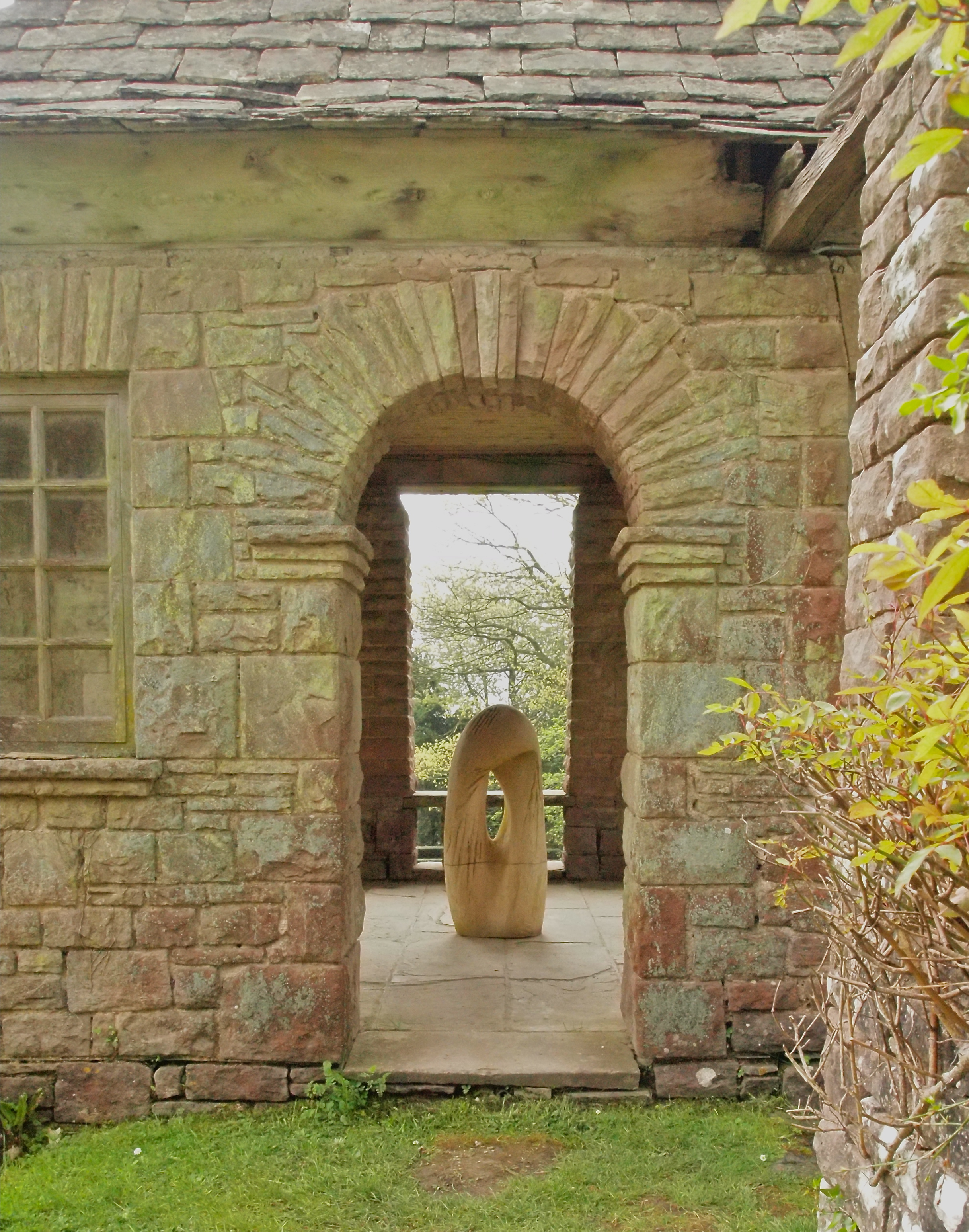
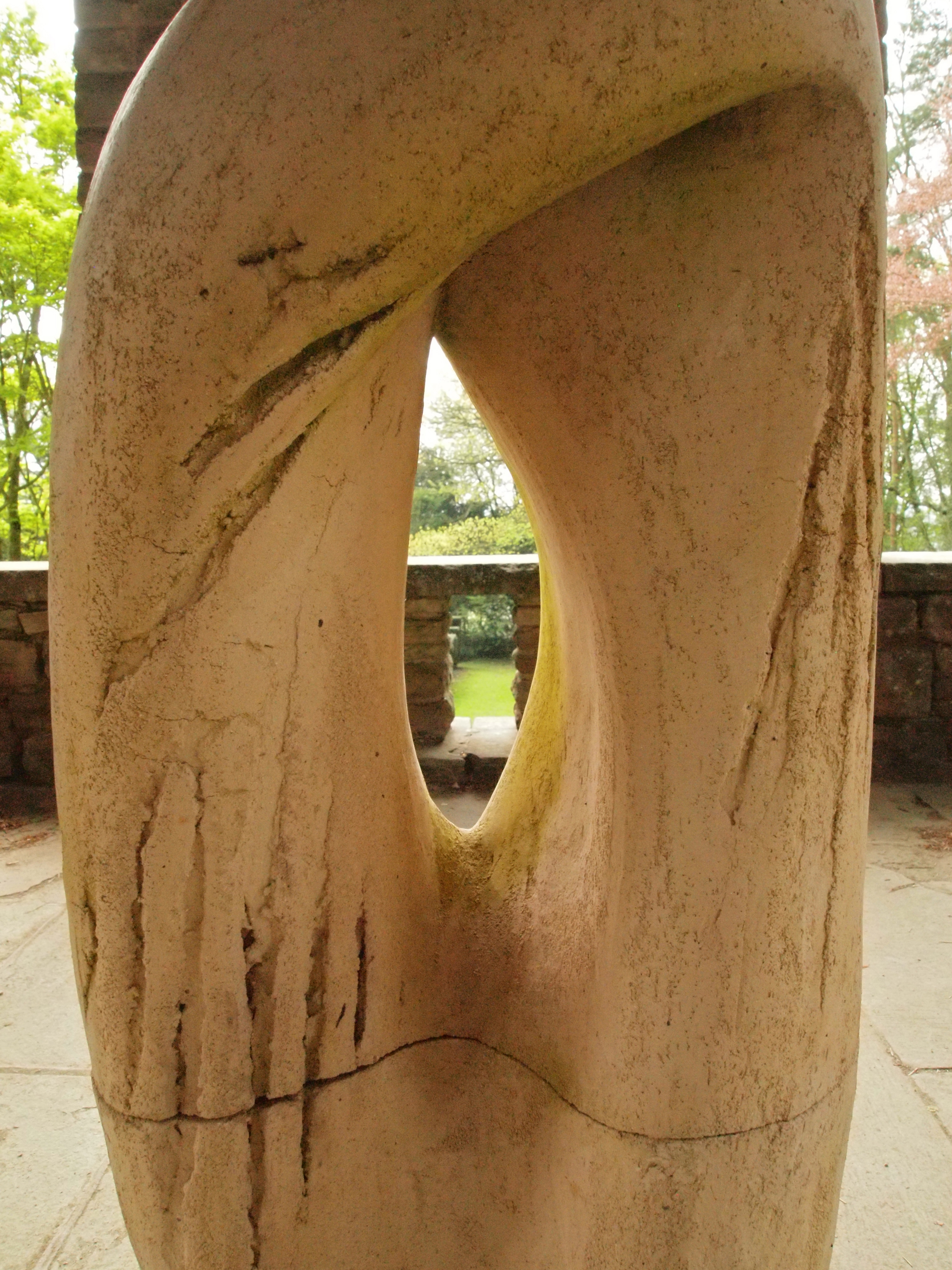
_F147690A Sculpture will transform any Garden, huge or pocket-sized, elaborate or austere. It will need to be made of beautiful, quality materials that have a radiance complimentary to your gorgeous plants. A piece needs to be frost-proof and easily cleaned. No material is as durable or as low maintenance as high-fired Clay.

IMG_20190504_180102126

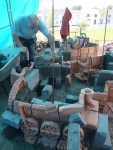
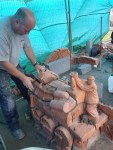
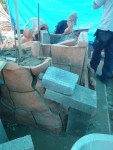
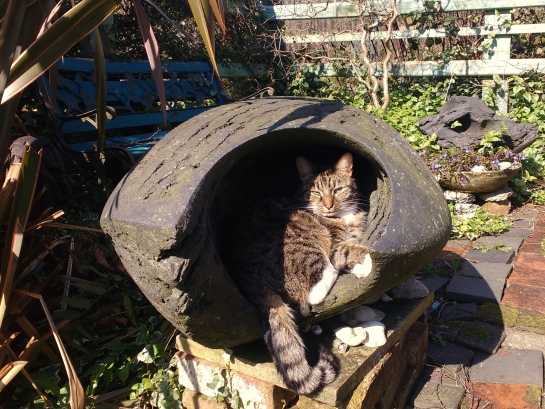
I make simple , movable plinths with old bricks and attractive stone paving tiles. Dig a hole and put in some bricks to make a foundation if the Sculpture is tall or very heavy, then build a hollow plinth with a small doorway that can double as a safe, cosy home for wild-life. If security is an issue or the piece is tall and vulnerable to high winds sink a stake into the ground, build the plinth around this and have the stake go into the Sculpture- many of my Sculptures are hollow and you can set them securely with cement if needs be.IMG_20190504_175930057My garden is 8 years old and is now really coming into it’s own. IMG_20190328_105048782IMG_20190504_180149583

IMG_20190504_175952314

IMG_20180603_090657302

IMG_20180526_130818064

IMG_20190504_180247885

The River, commission.

The River, commission.

Wyvern II, 70cm H x 52cm W. £850.

Wyvern II, 70cm H x 52cm W. £1100. (sold)

OLYMPUS DIGITAL CAMERA

Up is Down XV, £300 (sold)

OLYMPUS DIGITAL CAMERA

Harbinger I, £600. (sold)

OLYMPUS DIGITAL CAMERA

Up is Down XVI, 26cm H x 56cm L, £300.

OLYMPUS DIGITAL CAMERA

Up is Down II, 42cm H x 90cm L, £950.

OLYMPUS DIGITAL CAMERA

Half a Century III, 40cm H, £150.(sold)

OLYMPUS DIGITAL CAMERA

Some of the Sculpture is fresh from the Kiln and new work will be on the go in the Studio.

River Harbinger, 125cm H, £950

River Harbinger, at Wyndcliffe Court Sculpture Garden, 125cm H, £950 (sold)

OLYMPUS DIGITAL CAMERA

The River III, 80cm H, £500

The River III, 80cm H, £500 Sold

OLYMPUS DIGITAL CAMERA

The Edge III, 57cm H, £600, (sold).

I freely admit I spend countless hours staring into the pond ''thinking''...there are Newts !!

Callipygous, 41cm H x 73cm L, £600.

Callipygous, 41cm H x 73cm L, £600. (sold)

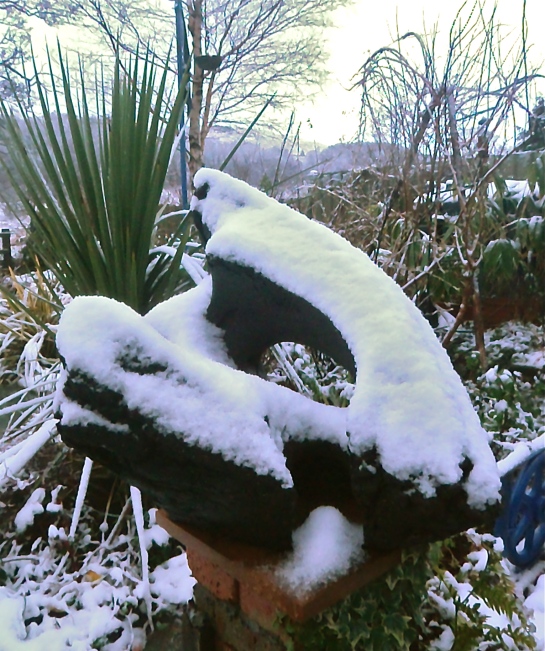
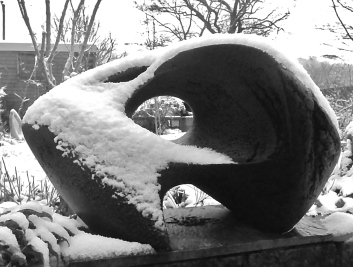
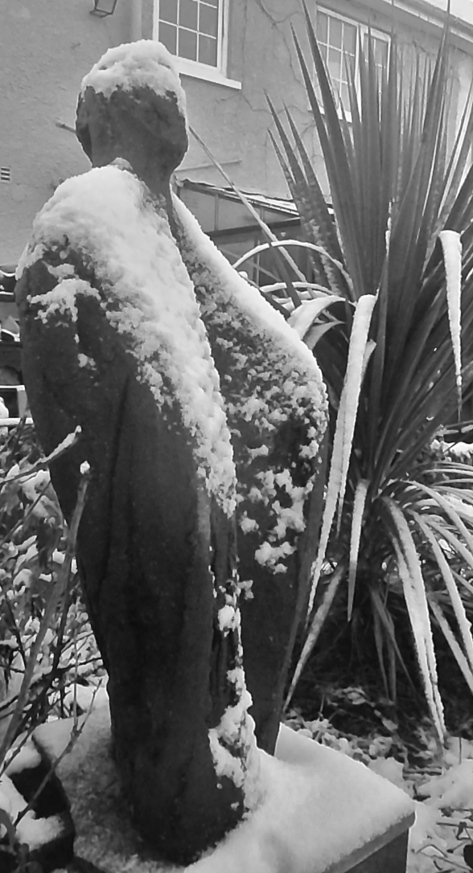
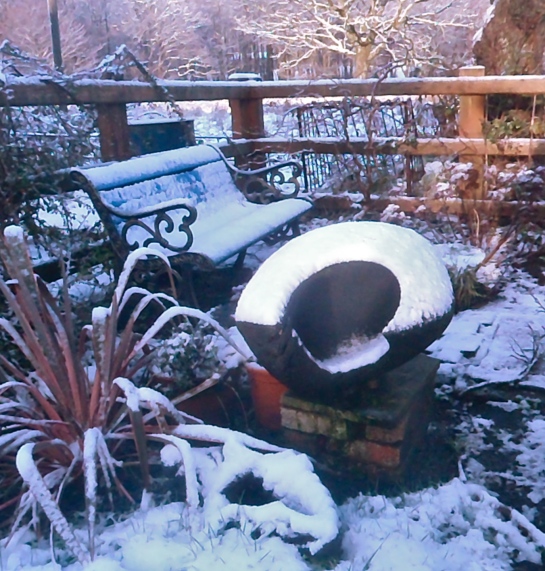
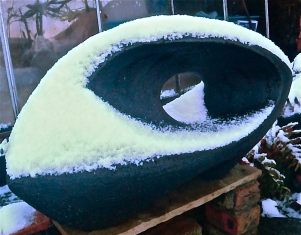
In the winter sculptures give the garden focal points and structure while the plants rest.

OLYMPUS DIGITAL CAMERA

Up is Down IV, 44cm H x 58cm L, £2400 (sold)

OLYMPUS DIGITAL CAMERA

Up is Down II, 80cm L, £300

OLYMPUS DIGITAL CAMERA

Harbinger I, £600. (sold)

The Garden backs right onto the wonderful country-side of the Brecon Beacons National Park

Osprey Studios Garden backs right onto the wonderful country-side of the Brecon Beacons National Park

Sculptures will define each area of your garden. This patio at the end of the garden is a calm, reflective place with dappled shade in the summer and warm sun in spring and autumn. In the winter the sculpture stands out and is eye catching from the house.

OLYMPUS DIGITAL CAMERA

Up is Down II, 41cm H x 80cm L, £300.

OLYMPUS DIGITAL CAMERA

Musings, 21cm H, £150. (sold)

_F147695

Musings, 20cm H, £150.(sold)

_F147699

The Edge XI, 77cm L x 49cm H, £300

The Edge I , 52cm H, £730.(sold)

The Edge I , 52cm H, £730.(sold)

The Edge XII, 71.5cm L x 46.5cm H x 40cm D.

The Edge XII, 71.5cm L x 46.5cm H x 40cm D. £1400 (sold)

The Edge XI, 77cm L x 49cm H x 40cm D.

The Edge XI, 77cm L x 49cm H x 40cm D. £300

Wyndcliffe Court Sculpture Gardens.

Henry Moore said that a sculpture was not complete until it was in the place it’s owner chose for it. It is wonderful to see my pieces transformed by new settings; it is the best part of delivering work to Exhibitions.

Wyndcliffe Court is a truly lovely place. You follow a narrow winding road past old-fashioned meadows and woodland to reach the beautiful house.

Wyndcliffe Court has extensive, mature Topiary.

Wyndcliffe Court has extensive, mature Topiary.


Wyndcliffe Court Gardens are Grade II listed and designed in the Arts and Crafts style. Situated along the Wye Valley between Chepstow and Tintern, they are beautiful formal gardens with views to the south and east. Open every weekend, they are showcasing contemporary sculptures by local and well-known British artists. Open from 2nd May – 28th September 2014 three sculpture shows will run consecutively, each collection featuring hundreds of sculptures to suit all tastes in a wide variety of mediums, sizes and styles situated throughout the garden and offering the opportunity to view and purchase beautiful sculpture with an outstanding backdrop. 


The Gardens are full of unusual, breath-taking, mature plants.

The Gardens are full of unusual, breath-taking, mature plants.

The couple running this new venture are both Artists themselves. They are wonderfully down to earth and very knowledgable about Contemporary Art. They charge a modest Commission and are very supportive to their Artists so prices there are extremely competitive. There is a wide range of styles and materials on show across the enchanting Gardens. There is a delightful Shop and the most perfect Terrace Tea-shop. Their Website is very helpful.

Standing Form, 110cm H, £650

Standing Form, 110cm H, £650

Standing Form, 110cm H, £650

Standing Form, 110cm H, £650

Callipygous, 41cm H x  73cm L, £600.

Callipygous, 41cm H x 73cm L, £600.


Serenity, 53cm H, £625

Serenity, 53cm H, £625

River Harbinger, 125cm H, £950

River Harbinger, 125cm H, £950

River Harbinger, 125cm H, £950

River Harbinger, 125cm H, £950

Up Is Down X, 52cm W, £550

Up Is Down X, 52cm W, £550

Up is Down IX, 57cm W, £550

Up is Down IX, 57cm W, £550


Studio Diary; The Tumble Commission, part 3.

The shape looks crazy at this point.

OLYMPUS DIGITAL CAMERA   OLYMPUS DIGITAL CAMERAOLYMPUS DIGITAL CAMERA

The first draft of the details can go on; the most important thing right now is to get good joins for the clay.


OLYMPUS DIGITAL CAMERAOLYMPUS DIGITAL CAMERA

OLYMPUS DIGITAL CAMERAOLYMPUS DIGITAL CAMERAOLYMPUS DIGITAL CAMERA


OLYMPUS DIGITAL CAMERA When the clay has hardened these can be touched up by carving with a delicate tool. These images were taken from archive pictures of 2 mines and the Railway local to Tumble. Apparently the Train that ran from Great Mountain Colliery was the first ever passenger line.

120005_ILL2944 Morlais-Colliery-2 images-24

OLYMPUS DIGITAL CAMERA

I’m using smaller coils and each stage is taking longer.It is just approaching the point where the central hole will form and the top edges start to meet- lets hope my measurements were right! If it doesn’t meet properly I’ll cut out large sections and re-do them.

The props are getting more inventive!

OLYMPUS DIGITAL CAMERA OLYMPUS DIGITAL CAMERA OLYMPUS DIGITAL CAMERA OLYMPUS DIGITAL CAMERA

Those out-side supports will stay in place until after the upper parts are cut and lifted off. In theory it would be self-supporting….but if it collapsed it would do it fast! The final, fired and installed Sculpture will have cement and steel rods inside so it will be strong enough to climb on.

Studio Diary, The Tumble Commission, part 2.

The Photography Shoot was even better than I had expected; stunning weather, lovely people exchanging ideas, a great lunch and Stephen Foote working with grace and charm, taking time with each person to be sure he got what they hoped for.

The Studio had been scrubbed down and tidied so Steve’s kit didn’t get dusty and the Commission  wrapped in plastic to rest and let the water in the clay  settle. It was great to have a few days break then un-wrap the piece in a clean room and review the progress with fresh eyes.

OLYMPUS DIGITAL CAMERA      The build method is the same as for the Monumental Sculptures but scaled down. The walls are thinner , the coils smaller , but the same sort of supports are used. The final sections will be much bigger so where the cuts will be needs to be pre-planned and internal structure put in to support the sections through the fire.


OLYMPUS DIGITAL CAMERA


Because the form shrinks as it dries, internal supports are clay and shrink with the form and external ones need to allow shrinkage or only be used for short periods. Quality memory foam is ideal because it lets the clay shrink yet will hold up surprising amounts of weight.The finger marks also support the walls and are left on the inside and only smoothed away on the outside after the section has gone firm.


OLYMPUS DIGITAL CAMERA


The clay is Scarva’s Earthstone Crank Material, ES50, and it is awesome. Their previous Crank had fantastic build quality but it was a minging colour wet and fired unless you put something made in Black Chunky in the kiln with it – then it took on a lovely gold shade. This new Crank is even better to use and will fire to very nice pale gold ideal for the setting.


OLYMPUS DIGITAL CAMERA


The lower section will stay wrapped most of the time to slow the drying and allow the water time to drop. I believe this makes the walls stronger but that might be nonsence. Each Clay-person develops their own relationship with their clay and techniques that are a breeze for one might be chaos for another. I started as Coil-builder 34 years ago and over time I’ve added a lot of side-shoots to my method.


It is 3/4 built, 225kgs of clay, 95cm high. I have definatly done the easy bits – from here on up it will be very slow; smaller coils added in small doses. In-between I’ll work on the surface images and the edges. This initial stage is building the basic form. A lot of clay will be added to bring out the curves and images. That will be left to harden and then the whole piece will be re-fined with subtractive methods. 3 steps forward , 2 steps back, slow and steady.


Studio Diary, The Tumble Commission, part 1.

The Scale Model for a lovely commission for a beautiful Care Home in Carmarthenshire got a very warm and positive response and after months of workshops, planning and very careful thought the build has started.

As usual I’ve over -designed for the budget… but that’s my prerogative- I always stick to my quoted fee and how many hours I put in is up to me.I get a buzz out of challenge and this piece has steep leans , a very complex form and very strong themes that must be stuck to.

OLYMPUS DIGITAL CAMERA  It has been developed from content gathered from other Artists on the Team working in a range of creative styles and  with some extraordinary Primary School pupils.

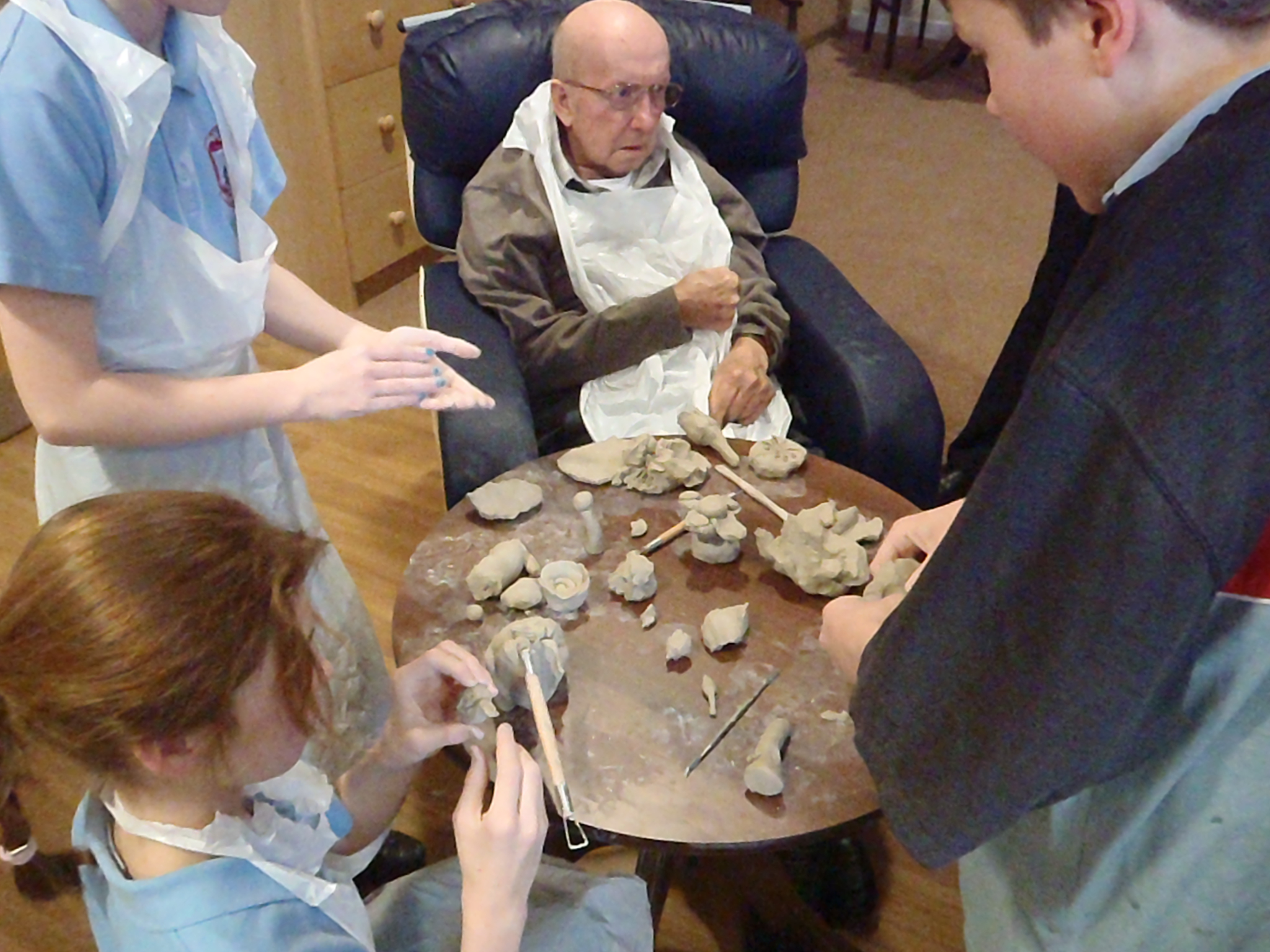
The children’s ideas were so sophisticated, profound and complex. For example; After spending a series of workshops with the Home’s Residents making tiles for the Plinth, they built the idea that life is a journey full of change and phases so they wanted to see a pathway that traveled around the sculpture. They wanted a warm , welcoming form that harnessed the rain ( that falls very regularly here in Wales!) to create pools and flowing rivers that represented the Love that is all around us and flows through our lives. Wonderful!

Many of the Residents have Dementia and all are very disabled. But they joined in, charmed by these adorable kids, and it was their warmth and sincerity the children picked up on. They talked about many of the harsh realities of their long lives; war, poverty, mining, loss.And the joys; the beautiful landscape of the country they love, pets, family, work.


SDC11609


OLYMPUS DIGITAL CAMERAIMG_1416


DSC_0578OLYMPUS DIGITAL CAMERAOLYMPUS DIGITAL CAMERA


OLYMPUS DIGITAL CAMERA


OLYMPUS DIGITAL CAMERA

When your Commissioners pour so much of themselves into the consultation phase you owe them something stunning. That includes Arts Care Gofal Celf  who are running this 2 year, multi -Artist project  with Gwalia and they are both a joy to work for.

So this piece is full of metaphors and symbols. And, I hope, the grace and integrity of the many people who brought it together.

OLYMPUS DIGITAL CAMERA

OLYMPUS DIGITAL CAMERAOLYMPUS DIGITAL CAMERA

Near the Studio is the beautiful valley I go to regularly (the River Series came from there) and it is the perfect place to support this Sculpture. And it certainly rained enough this winter.

OLYMPUS DIGITAL CAMERAOLYMPUS DIGITAL CAMERAOLYMPUS DIGITAL CAMERA


OLYMPUS DIGITAL CAMERA


The Sculpture will be 1metre 40cm high plus the Plinth and 1m 80cm wide.

I always make scale model people too so I have  the eye-lines right. They help to illustrate the scale.                                                                                                                                 OLYMPUS DIGITAL CAMERA


Measuring carefully from the Model the piece is coil-built using a variety of coil methods . The details are roughed in as the lower sections will necessarily get hard to support the weight of the following layers. Timing is everything. I do use fans and supports but if you mess too much with the drying phases you may well get cracks. If you work too fast it will collapse and I hate it when that happens.

OLYMPUS DIGITAL CAMERAOLYMPUS DIGITAL CAMERAOLYMPUS DIGITAL CAMERA There are internal support-walls and buttresses. The piece will be cut in large sections for the firing and these are pre-planned very carefully. The structure has be strong while wet , when dry,when being dismantled and moved to the kiln , through the fire, when being installed and then when it stands for decades, centuries even, in a public place. The site in this instance is a very lovely , sheltered Court-yard Garden with handsome landscaping. There wont be a problem with people climbing on it etc so I could allow some delicacy  but non-the-less it is a sturdy design although I am aiming for a light, flowing feeling.

Wyndcliffe Court Sculpture Gardens.

Henry Moore said that a sculpture was not complete until it was in the place it’s owner chose for it. It is wonderful to see my pieces transformed by new settings; it is the best part of delivering work to Exhibitions.

Wyndcliffe Court is a truly lovely place. You follow a narrow winding road past old-fashioned meadows and woodland to reach the beautiful house.

Wyndcliffe Court has extensive, mature Topiary.

Wyndcliffe Court has extensive, mature Topiary.


Wyndcliffe Court Gardens are Grade II listed and designed in the Arts and Crafts style. Situated along the Wye Valley between Chepstow and Tintern, they are beautiful formal gardens with views to the south and east. Open every weekend, they are showcasing contemporary sculptures by local and well-known British artists. Open from 2nd May – 28th September 2014 three sculpture shows will run consecutively, each collection featuring hundreds of sculptures to suit all tastes in a wide variety of mediums, sizes and styles situated throughout the garden and offering the opportunity to view and purchase beautiful sculpture with an outstanding backdrop. 


The Gardens are full of unusual, breath-taking, mature plants.

The Gardens are full of unusual, breath-taking, mature plants.

The couple running this new venture are both Artists themselves. They are wonderfully down to earth and very knowledgable about Contemporary Art. They charge a modest Commission and are very supportive to their Artists so prices there are extremely competitive. There is a wide range of styles and materials on show across the enchanting Gardens. There is a delightful Shop and the most perfect Terrace Tea-shop. Their Website is very helpful.

Standing Form, 110cm H, £650

Standing Form, 110cm H, £650

Standing Form, 110cm H, £650

Standing Form, 110cm H, £650

Callipygous, 41cm H x  73cm L, £600.

Callipygous, 41cm H x 73cm L, £600.


Serenity, 53cm H, £625

Serenity, 53cm H, £625

River Harbinger, 125cm H, £950

River Harbinger, 125cm H, £950

River Harbinger, 125cm H, £950

River Harbinger, 125cm H, £950

Up Is Down X, 52cm W, £550

Up Is Down X, 52cm W, £550

Up is Down IX, 57cm W, £550

Up is Down IX, 57cm W, £550


Powys Arts Month 2014, Open Studio and Garden Exhibition.

Osprey arts mo flyer


All over Powys in Mid Wales, UK,  Artists and Craftsmen are opening their Studios and putting on special events to share work. It is a great time to find someone whose style appeals to you and go ask them about projects of your own. We all love talking shop and encouraging others with their creativity. It is an excellent  event for Bargains as Artists spring-clean their Studios and admit it is time to part with secret favourites.

Osprey Studios is open every weekend in May or phone and book any  time that would be more convenient. Evenings are a tranquil, charming time in the Garden.

Everything in this section is under £30.

Everything in this section is under £30.


Osprey Studios. Easy parking and access.

Osprey Studios. Easy parking and access.


Some of the Sculpture is fresh from the Kiln and new work will be on the go in the Studio.

Some of the Sculpture is fresh from the Kiln and new work will be on the go in the Studio.

Beautiful Penpont ,half way between here and Brecon has an Arts Month site too and is a glorious place to visit. The ‘Visit The Studio’ page here on this site has other attractions, directions  and details for having a lovely day here in the south-western corner of the Brecon Beacons National Park.

You can show up on the day for my 2 workshops but booking in advance will secure your place.

You can get a feel for my best white clay, Scarva Architectural,on the Join-in Sculpture  which will be on the go all month and I’ll put out my Momentum wheel for anyone to try for free too.

A Join In Sculpture at Brecon Jazz with The Big Skill.

A Join In Sculpture at Brecon Jazz with The Big Skill.

The lovely kids visiting Osprey Studios with The Chernobyl Life Line trying out the Momentum Wheel

The lovely kids visiting Osprey Studios with The Chernobyl Life Line trying out the Momentum Wheel

On the 17th the wonderful Photographer, Stephen Foote (see links) that did my best pictures is coming here for anyone else needing top quality images at an affordable price. Everyone is welcome to visit on that day- it will be busy and very interesting to see Stephen Foote working in the Studio.

osprey photo sesion2,PAM 2014

I have had a massive clear-out; I’ve got a large Commission to build in the Studio. It will be on the go during Powys Arts Month and your feed-back during the build would be a great help. It is not going to be an easy one! I’ll have a lot of brand-new, never shown, work here. You can handle the range of  specialist clays I use to see if they might suit you. And there’s also some fab seconds  for sale including my Gwenllians.

Taken as a pair they will be just £500 or £300 each. Some of my other smaller seconds will be £1-£30. They are all frost proof.

OLYMPUS DIGITAL CAMERA

Gwenllian was an actual historical Welsh Warrior Princess. Both Sculptures of her are life-sized and fully frost-proof.

Gwenllian was an actual historical Welsh Warrior Princess. Both Sculptures of her are life-sized and fully frost-proof.

Everyone including Schools and Families will be  very welcome  to Osprey Studios during Powys Arts Month. You can relax in the Garden with a complimentary drink and the kids can play with clay for as long as you like.


Studio Diary 25 March 2014

Up Is Down is a fascinating theme that is leading down all kinds of roads. Only time will tell how many of them are very bad….a percentage of my work is regularly too awful to fire – that’s the price of experimenting and taking risks.

I’m working for a very creative Company in the USA involving fire. And I have started a collaboration with  Photographer Stephen Foote (see Links for his Web-site) Both of these projects are benefitting from the early work of Up Is Down and now they are leading it with the movement and pull of forces and the changes that leaves on a form.

OLYMPUS DIGITAL CAMERA

Music is still key. A central space for Fire  and the intension to have no

or little base is a starting

template for the clay-armatures.


OLYMPUS DIGITAL CAMERA


OLYMPUS DIGITAL CAMERA

Steve and I visited Bracelet Bay in the Mumbles, Swansea,one of the first of many spectacular  beaches around the Gower Peninsula. It was a strange, foggy day, very atmospheric, with the Fog-horn sounding in the mist. The feeling of the draw and strength of tidal waters pulling through the forms of stone is accentuated by faces covered in barnacles and pebbles left behind.

1981984_10203331966200635_1180227792_n
 Steves pictures will be the reference point for the next batch of Up Is Down pieces.

10003791_10203331962960554_1179723863_o

The resulting Sculptures will then potentially inform his next set of Pictures. And so on until it runs out of steam.

_F146722


10010298_10203331966960654_2005679223_o

The Up Is Down Series .

Up is Down IX, 20cm H x 49cm L x 31cm D, £800

Up is Down IX, 20cm H x 49cm L x 31cm D, £800

The Up Is Down Series started in November 2013. As often happens there was a progression from a previous Series ( the Edge). I knew there was a shift, and I knew what it was about, but couldn’t find the words for it. Sculpture is my ‘first language’, the one I think in and use to work out my understanding of the world. This is how it goes for many Artists, it’s not unusual.

Up is Down V, back view

Up is Down V, back view. Links to The Edge Series are obvious in this piece.

I’ve been describing our perceived borders in The Edge Series but we don’t actually possess  clear borders; the cloud of particles and especially  bacteria that make up us dissipates and interacts with our surroundings and fellows , interchanging constantly. When you leave the Forest some of it comes with you , some of you is left behind.We are constructed from atoms that have been used to form countless other things since the Big Bang. After death those atoms will move on to build other parts of the World. As my son put it beautifully when he was 5 ; ”So we become part of the mountain? Good.”

Up is Down V, 44cm H x 58cm L x 50cm D, £1700

Up is Down V, 44cm H x 58cm L x 50cm D, £1700. The Osprey theme recurs constantly in my work. Ospreys make their living crossing  the boarders between the earth,the sky and water.

Up is Down VII, back view

Up is Down VII, back view. Many of these pieces relate to the Half A Century Series.

Up is Down VIII, 18cm H x 43cm L x 30cm D, £800

Up is Down VIII, 18cm H x 43cm L x 30cm D, £800

Up is Down VI, 25cm H x 31cm L x 17cm D, £1100

Up is Down VI, 25cm H x 31cm L x 17cm D, £1100

http://www.sciencemusings.com/2008/01/key-to-riddle.html

by Chet Raymo

‘Behind the apparent decay and new growth the atoms endure, those mysterious and eternal particles that contain within themselves tendencies to combine and recombine in endlessly creative ways.

The church, the village, the rank tropical growth, the creatures that creep and fly and crawl are composed of recycled star dust, atoms forged billions of years ago in hot, massive stars, here woven by the hands of energy and entropy into a fabric of gorgeous complexity.

I went there for the same reason the naturalist/scientist Rachel Carson went to the edge of the sea. She wrote: “Underlying the beauty of the spectacle there is meaning and significance. It is the elusiveness of that meaning that haunts us, that sends us again and again into the natural world where the key to the riddle is hidden.”’

Up is Down IV, 31cm H x 58cm L x 37cm D, £1200

Up is Down IV, 31cm H x 58cm L x 37cm D, £1200

The title, Up Is Down, came from Hans Zimmer, the fabulous Composer and his brilliant piece of the same name  in Pirates of The Caribbean III. I have all 4 Pirates , Rango,and The Lone Ranger  sound-tracks on shuffle most of the time these days. Fantastic stuff,full of wild leaps of emotion , heady ideas and humour. His version of The William Tell Overture for The Lone Ranger is hilarious and wonderful.

Like the Up Is Down scene in Pirates III,”At Worlds End” this Series breaks away from the normal parameters that have defined my forms, particularly the base contacting with the table. It will take me a while to get this right but in theory the Sculptures can be turned and displayed any way you like ; the full 360 should have impact. The weight of the wet clay makes this very difficult to pull off….! I’ll get there. I will work smaller to reduce the weights and allow me to move through new forms more quickly. It is a massive challenge for someone who started out as a Vessel builder seeped in the tradition of the classic Vase form with it’s reliable base. But even in my earliest work , 30 years ago , that base kept trying to disappear. A-symatry and unlikely balance have always been my trade-marks.

Up is Down VII, 23cm H x 40cm L x 18cm D, £1200

Up is Down VII, 23cm H x 40cm L x 18cm D, £1200 

This piece still has a ‘base’ but it has nearly gone. It is not necessary  to loose the base for the piece to make sense; I work to Themes but I don’t set rigid rules because that would be trite. It is very difficult to trust that the Forms will evolve in a valuable way  given the freedom but if you don’t this work-meathod is meaningless. The idea is too prepare your craftsmanship, memory and sub-concious with as much expertise as you can. Then you add Music and  give your hands and clay free reign.

A new Up Is Down in progress

A new Up Is Down in progress

In Progress

Up is Down I ,41cm H x 80cm L x 48cm D, £1400 In Progress

Up Is Down II in progress

Up Is Down II in progress

 Extracts from J.P. Hodin, Barbara Hepworth, London, 1961, Two Conversations with Barbara Hepworth: ‘Art and Life’ and ‘The Ethos of Sculpture’, pp. 23–24(in conversation with J.P. Hodin, 18 August 1959)

“Art at the moment is thrilling. The work of the artist today springs from innate impulses towards life, towards growth – impulses whose rhythms and structures have to do with the power and insistence of life. […] In the past, when sculpture was based on the human figure, we knew this structure well. But today we are concerned with structures in an infinitely wider sense, in a universal sense. Our thoughts can either lead us to life and continuity or […] the way to annihilation. That is why it is so important that we find our complete sense of continuity backwards and forwards in this new world of forms and values. I see the present development in art as something opposed to any materialistic, anti-human or mechanistic direction of mind.”

Up Is Down III, 20cm H x 40cm L x 29cm D, £800

Up Is Down III, 20cm H x 40cm L x 29cm D, £800

Detail, Up Is Down VII

Detail, Up Is Down VII

Detail,Up Is Down VI

Detail,Up Is Down VI

Building Brick Sculptures on a Monumental Scale.

Whole buildings are built from clay-mud all over the world. They last for centuries and can be huge. They are all built  basically like coil-pots.

I build the structure of the big sculptures in much the same way, add on  the artwork and  then cut them up (hollowing where necessary) for firing. These days I use this method for most of my sculpture but with smaller pieces (under 2 metres)I work quite intuitively. The big ones you need to plan like a military campaign because supports will need to be built in from the outset in order to be rigid enough to work and to cut the piece up. Budgets must be stuck to and Volunteer’s time is very precious.

Parc Calon Lan, Blaengarw , South Wales

Calon Lan, Parc Calon Lan, Blaengarw, South Wales.
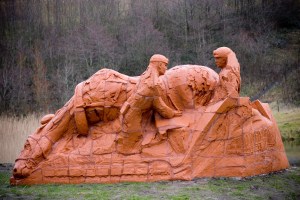
Ocean Colliery Pit Marker,5m long x 2 m high, Blaengarw ,South Wales

Ocean Colliery Pit Marker, 5m long x 2 m high, Blaengarw, South Wales.

This is a very different method from building with un-fired Bricks, which is mostly a subtractive, carved process. Using the raw clay allows for a lot of adding and modelling. They are both great techniques and Gwen Heeney’s excellent book ”Brickworks” is well worth reading. It is full of good advice.
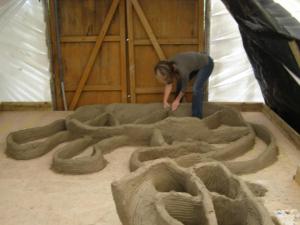
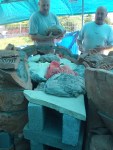
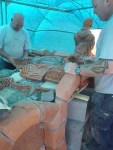
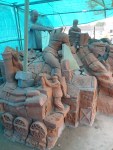
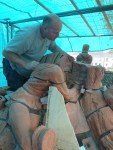
Llanharran's hourse and Cefn Pennar's Dragon,in Groundwork's Polytunnel,Aberdare.

Llanharran’s horse and Cefn Pennar’s Dragon,in Groundwork’s poly-tunnel, Aberdare.

After talks/workshops with the local community, research, writing a plan-of-work, time-table  and making a  Scale Model, draw the out-line of the sculptures foot-print onto the floor.

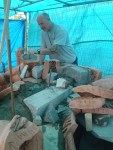
Using very soft  Brick-clay  lay down first layer at around 5 cm thick. Allow to stiffen. Soften top edge w/ water, rub to a slip, add next layer (approx 10kg clay ‘coil’ 40cm long), ensure good join, draw the clay upwards. You can get about 30 cm in height. You can lay a strip of plastic along the top to keep that edge soft for the next join. Joints must be perfect so that the final sections are strong enough to handle.
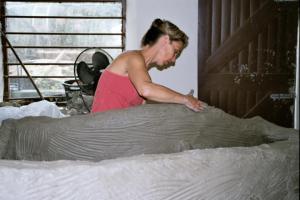
Calon Lan ;1/2 way up, basement of the Sculpture Studio,Katie St,Blaengarw.

Calon Lan; 1/2 way up, basement of the Sculpture Studio, Katie St, Blaengarw.

Note the finger marks; leave these: use them as strengthening for the walls in the manner of corrugation.
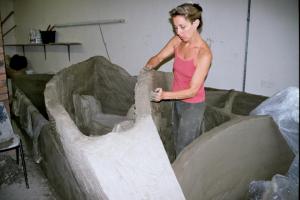
Calon Lan,Blaengarw

Calon Lan,Blaengarw

Inner ‘Support Walls’ are built thinner, inside the form. Clay supports shrink with the Sculpture. They will be discarded and re-cycled when the Sculpture is cut up.

Memorial to Gito Neath Bran ,Llanwonno,built w/ Groundwork Aberdare

Memorial to Guto Nyth Bran, Llanwonno, built w/ Groundwork Aberdare.

Like all coil-pots, lower sections are wrapped in plastic to prevent over-drying; you will need to be able to cut through all layers so they must not get too hard and over-drying/shrinking will cause nightmare cracks. The thickness of the walls can be reduced as you go up to reduce weight.
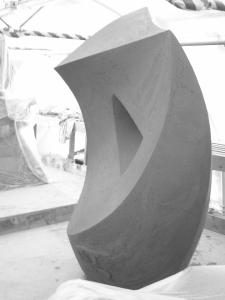
Memorial to Gito Nith Bran,Llanwonno,

Memorial to Guto Nyth Bran, Llanwonno.

Chunks of memory-foam can be put inside to support horizontal walls; the foam will shrink w/ the clay.
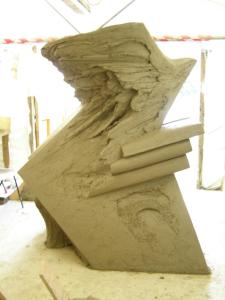
Memorial for Maerdy Workingman's Hall built in the Polytunnel w/ Groundwork,Aberdare

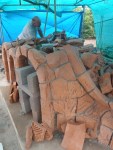
Memorial for Maerdy Workingman’s Hall built in the polytunnel w/ Groundwork Aberdare. On the bottom-left of this sculpture you can see a clay support holding up that leaning wall, built in from the first layer. This will be removed once the huge weight (2 tons) of the upper parts of the sculpture are cut away during the dismantling .


Balarat Pit Marker built in Pontycymmer w/ The Creation Development Trust , Blaengarw

Balarat Pit Marker built in Pontycymmer w/ The Creation Development Trust , Blaengarw

Wooden supports can’t shrink w/ the form so may cause bad cracks but they have their place.
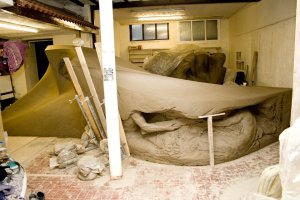
Balarat Pit Marker

Balarat Pit Marker

We made 7 adjustable metal/plank brackets to support a wall that leaned outwards by nearly 40 degrees. They had to stay in place until upper sections were removed. There are whole sofa cushions inside supporting the roof!

Balarat is 6 metres long x 2 m high and took 7 tons of clay. We built it at the same time as Ocean Colliery Pit Marker (5m long, 5 tons of clay), seen in the background. There is a lot of drying (timing is everything) so having 2 on the go really maximises the use of your budget; we were able to build and install these both for £40,000. Countless wonderful people were involved and it all took over a year.
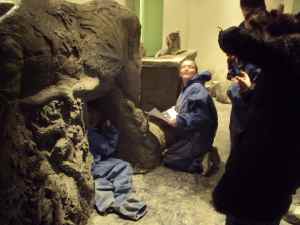
The Sirhowy Wyvern built w/ Time Banking Wales,Tredegar.

The Sirhowy Wyvern built w/ Time Banking Wales, Tredegar.

The Sirhowy Wyvern has a tunnel running through it (with art-work inside of children working in coal mines, some done by kids like these awesome girls from the Youth Club). We had one clay support-wall half way along to support the roof and this allowed us to get inside from either end to work.

Gito Nith Bran Memorial detail; the Salmon,oldest and wisest of all the creatures in Celtic Mythology.

Guto Nyth Bran Memorial detail; the Salmon, oldest and wisest of all the creatures in Celtic Mythology.

To add on art-work: spend a lot of time softening the surface, add clay, ensure a good join, add clay to block-out art work, wrap in plastic to allow the water to travel from the soft clay into your hardened wall. Un-wrap when the clay has all reached a similar hardness + complete the art-work.
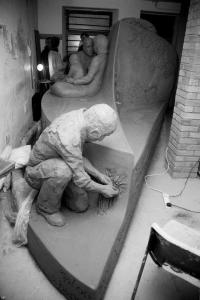
Calon Lan , Blaengarw

Calon Lan, Blaengarw.

As walls are complete they can be smoothed, carved and art-work added and refined. All the tools are normal sized pottery tools and bits of wood. Plastic wrapping and containers of water placed inside can slow the drying, fans (pointed towards walls, not at the clay) and dehumidifiers can speed it up.

Calon Lan was the first really large build I did with a group and only the 3rd one I had done. Many people worked on this piece, using all sorts of techniques and styles. We had lively discussions about the building methods and art-work and worked it out between us. Especially with these early pieces it was terrifying! With each sculpture I have changed the technique a bit. You will do the same, adapting it to your style and clay.
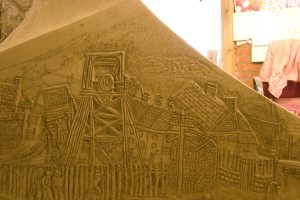
Wendy Sage's panel on Balarat

Wendy Sage’s panel on Balarat Pit Marker, Blaengarw.

This wall on Balarat was built extra thick in preparation for the remarkable volunteer, Wendy Sage, to carve on this fantastic view of the village taken from archive photographs. Wendy worked on this panel for 6 weeks and did a lot of the other art work on the Blaengarw Sculptures.

Ex-Miner , Jim.

Jim, an ex-miner and excellent painter, gave countless hours to all the Blaengarw Sculptures.
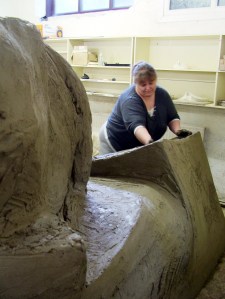
wonderful Volunteer , Sharon.

Sharon started out reluctantly helping with the foliage on Calon Lan and quickly became invaluable, working on all aspects of the Sculpture. Here she’s building the dram on Ocean Colliery Pit Marker.
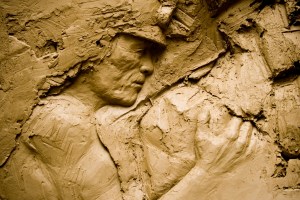
Sculpture1 001

We all worked on this difficult panel, taking turns to model or advise. Jim knew the ‘feel’ we were after from his time under-ground.
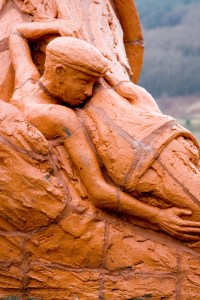
Ocean Colliery Pit Marker - detail

Ocean Colliery Pit Marker – detail

As soon as the top area is firm enough to handle you need to start dismantling the Sculpture. Cracks will be showing up as the whole thing tries to shrink.

Take photos all around the Sculpture. Enlarge + photocopy.

Start cutting from the top with a normal ‘cheese-wire’. Aim for around 30 cm square; sections that are too large will be hideously heavy, crack and worst, warp in the firing. Try and keep the edges of the sections at 90 degrees to the front surface for yourInstaller’s sake. Lay the sections onto memory foam so they don’t distort/get damaged. Draw on your photocopy  Photo-Map the cut’s shape and record the number. Mark the number on each side of the edges of the section (incase one number gets smudged). These Maps, numbers, a tracing, on plastic, of the outline left on the floor of the foot-print of the sculpture and the Scale model are now your most treasured possessions until the sculpture is installed and loosing them will haunt the many nightmares you will have about the whole process.

Once sections are stiff enough to handle without distorting trim away the excess thickness leaving a good 5 cm minimum. ‘Gouge’ out, using loop-tools (or an electric drill on leather-hard sections) a random pattern of channels in the back of the sections that will reduce the thickness to 2cm at any point, act as a grid of braces to deter warping and give excellent grip to the cement that will hold them all together. It’s got to be said: this is not the fun bit….

Dry slowly using a dehumidifier/memory foam support/regular turning for at least 5 weeks. Fire SLOWLY!!! Bear in mind that many brick-clays contain stones; these must be fired extremely slowly passed 500 degrees C to allow vaporised minerals to escape or your sections will ‘bloat’. Luckily I’ve never had this happen thanks to the kind guidance from the  guys at Coleford Brick and Tile who don’t find bloating a laughing matter even though a bloated brick looks like a rugby ball! Be wary, too, of the low melting point of some brick-clays.

I fired all the sections packed in the kiln on their edges (flat seems to invite cracks/distortion) in my Cromartie 16 cu ft Workhorse Electric Kiln in batches of up to 40 sections. 1 ton of sculpture seems to yield about 50 sections.

Installation needs an imaginative Builder with the patients of a saint who will, non-the-less, come to hate your guts. Lay a strong foundation w/ reinforced concrete, build an internal structure of breeze-blocks/infill/steel bars,’clad’ with the sections of sculpture and point up joints. Installation will generally use half your budget.

You can copy/print this next bit for your installer:

OLYMPUS DIGITAL CAMERAOLYMPUS DIGITAL CAMERAOLYMPUS DIGITAL CAMERAOLYMPUS DIGITAL CAMERAOLYMPUS DIGITAL CAMERAOLYMPUS DIGITAL CAMERAOLYMPUS DIGITAL CAMERAOLYMPUS DIGITAL CAMERAOLYMPUS DIGITAL CAMERAOLYMPUS DIGITAL CAMERAOLYMPUS DIGITAL CAMERAOLYMPUS DIGITAL CAMERAOLYMPUS DIGITAL CAMERAOLYMPUS DIGITAL CAMERAOLYMPUS DIGITAL CAMERAOLYMPUS DIGITAL CAMERAOLYMPUS DIGITAL CAMERAOLYMPUS DIGITAL CAMERAOLYMPUS DIGITAL CAMERAOLYMPUS DIGITAL CAMERA

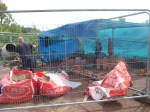
        Installing a ceramic sculpture with sections.

Sculptures made in brick, using any of the various techniques, is incredibly laborious. But they are more durable than any other material. They are the archaeology of the future. More people can be involved in making them and they can be much more affordable than other  materials. The process of the installation will be more like dry-stone walling than brick laying.

Using the Scale Model:

The scale model was used to build the form in wet clay. Changes will have been made to enhance the form in it’s full scale.

There is an 18% shrinkage from wet to fired with Coleford Brick clay so the scale model will be 18% too small.

Spacing and pointing will also affect the installed size.

So the scale model is only a useful guide during installation.

The Sections:

The sculpture is built as one in soft clay and then cut up.

Once the form is built it under-goes a controlled drying period to the point where it can be cut. Obviously the lower layers are very hard by that time, and the upper layers less so.

Cutting has to be done in such a way that the fragile form does not collapse. That is why the numbers follow the sequence they do and why the cuts are where they are.

Cutting up is very difficult and hard work. At each cut the Map is marked, numbered and the section numbered. Mistakes are easily made. 

The sections are heavy and can be awkward to lift. They are set down on memory foam and then trimmed back as much as possible. A grid of gouges in the back helps to hold the shape during drying/firing. Happily they also provide excellent grip during installation. Every care is taken but inevitably some get damaged. Once the clay has passed a certain point in drying it is best to repair this damage after the firing.

 Each section section is carefully handled/supported/turned during a long, very slow drying period of 6 weeks.

The sections will have been divided over a number of firings. No firing is the same and where the section was in the kiln also creates unique conditions. Because the shrinkage is so high ( 18%) and the Coleford Brick clay is being fired to a temperature close to it’s melting point to gain the near vitrification and strength, this may make significant differences to the fired section’s size.

So sections may well have warped, shrunk un-evenly and cracked. They can be trimmed or cut with power tools. Badly warped ones can be cut into several pieces so that they can set well in the form.

Priorities:

The parts that will be focal points and define the sculpture.

                                                      Edges.  Carvings.  Holes.

The hole is focal- people will usually go up close to the holes if they can. But they can be ground with power tools.

Edges can also be ground into line to a certain extent but it is very difficult to re-produce the right texture.

All three are very important but the carvings are the part that needs to be set most carefully.

The Foundation:

The installed sculpture may be solid with infill and very heavy. The foundations need to be adequate. Steel re-bars should be set to re-enforce /anchor the sculpture.

The Layers:

The installation can only progress one layer at a time, starting at the base. If the base layer is angled wrongly that error will magnify with each subsequent layer making it very difficult to look after your 3 priorities ( above).

Careful planning of each layer will make a big difference.

Sections can be trimmed and spacing can be varied. Have a box of spare mosaic tiles/pebbles to decorate very wide gaps. Leave enough gap to point: This sculpture will stand for centuries and all precautions should be taken against water/ice.

         – Using the maps sort the sections into groups.

  • Using a washable paint write the numbers on the out-side of the section.
  • Using a marker-pen write the number of the adjacent section shown on the map, on the inner-edge. Also mark ‘top’, ‘base’ or a this way up arrow.
  • With smaller sculptures or parts like figures:

          Place paper or plastic on ground.

          Starting with the top layer, place the sections using stones/bricks/breeze blocks to support them. Make wedges/spacers and hold in place             w/ duct tape.

          where necessary fix sections together with quick drying cement ( this can be knocked off later.)

          Photograph/measure/make notes.

          Trace the ‘foot-print’ onto the paper. Cut it out and use to guide the next layer down.

         -With large/wide sculptures:

          Set the base layer. Support/space well as above. Hold the next layer sections to each join to check the consequent angles. Lay that next                 layer on the ground around the installed layer and check as much as is necessary that the fit is good.

  • Once you are sure they are correctly placed, fix them in with cement. When that is set put in your next layer of re-bars and infill.

Pointing:

Coleford brick clay is very dense and has extremely low porosity. Ensure your pointing material is suitable to the ceramic.

Red sand gives a good, long lasting match to terracotta colours.

Coloured mortar from Tarmac (http://www.tarmac.com/mortar/mortar/coloured-mortar/  ) are good.

Colour dyes do not last well in sun-light.


The Sirhowy Wyvern, Sirhowy Green, Tredegar, South Wales

The Sirhowy Wyvern, Sirhowy Green, Tredegar, South Wales

1048761_452135444882806_362683050_o

The whole process is spectacularly laborious!! And exquisitely low-tech. There is a job there for every Volunteer of every ability, from teen-age lads building the structure to Grans, kids and every-one in between doing art-work, people who like to stay clean doing research and collecting reference material, the local Cafe feeding you all the vast amounts of cooked dinners it will take to fuel the gruelling lifting and shifting required, people stepping in off the street to give you an invaluable ‘fresh eye’ on how it looks. The finished Sculptures will last for many generations, become landmarks and the pride of the area and finally the archaeology of the future.